
9 Best Kajabi Alternatives for Course Creators in 2026
How each pick stacks up on monthly cost, transaction fees, and built-in teaching tools.


Kajabi's top alternatives in 2026 include Fourthwall, Podia, Circle, Mighty Networks, Gumroad, Sellfy, Thinkific, Teachable, and LearnWorlds. Fourthwall's Free plan has no monthly fee and lets creators sell merch alongside their courses, while Kajabi's Basic plan starts at $179 a month.
Kajabi is known as an all-in-one platform for online courses, funnels, and email marketing. It’s a solid pick for established educators who want deep automation without piecing together separate tools. Creators choose it for the built-in marketing engine, including email sequences and sales pipelines.
But Kajabi’s depth comes at a high cost. Kajabi's entry-level Basic plan starts at $179 a month, and pricing climbs to $499 a month on the Pro plan. Kajabi also isn't built for merch or physical products, so creators who want to pair courses with branded apparel or other physical goods usually end up bolting on a second platform.
Many also outgrow Kajabi's contact and product caps faster than they expect, or find the automation tools more than they need for a smaller course business.
In this guide, we'll explore 9 Kajabi alternatives worth considering in 2026, like all-in-one creator commerce platforms and dedicated course and community tools, so you can find the right fit for what you want to sell.
Kajabi Alternatives at a Glance
1. Fourthwall
Average customer rating: Trustpilot: 4.3 (370+ reviews)
Fourthwall is the best alternative to Kajabi for creators who want to sell merch alongside their courses and digital products.
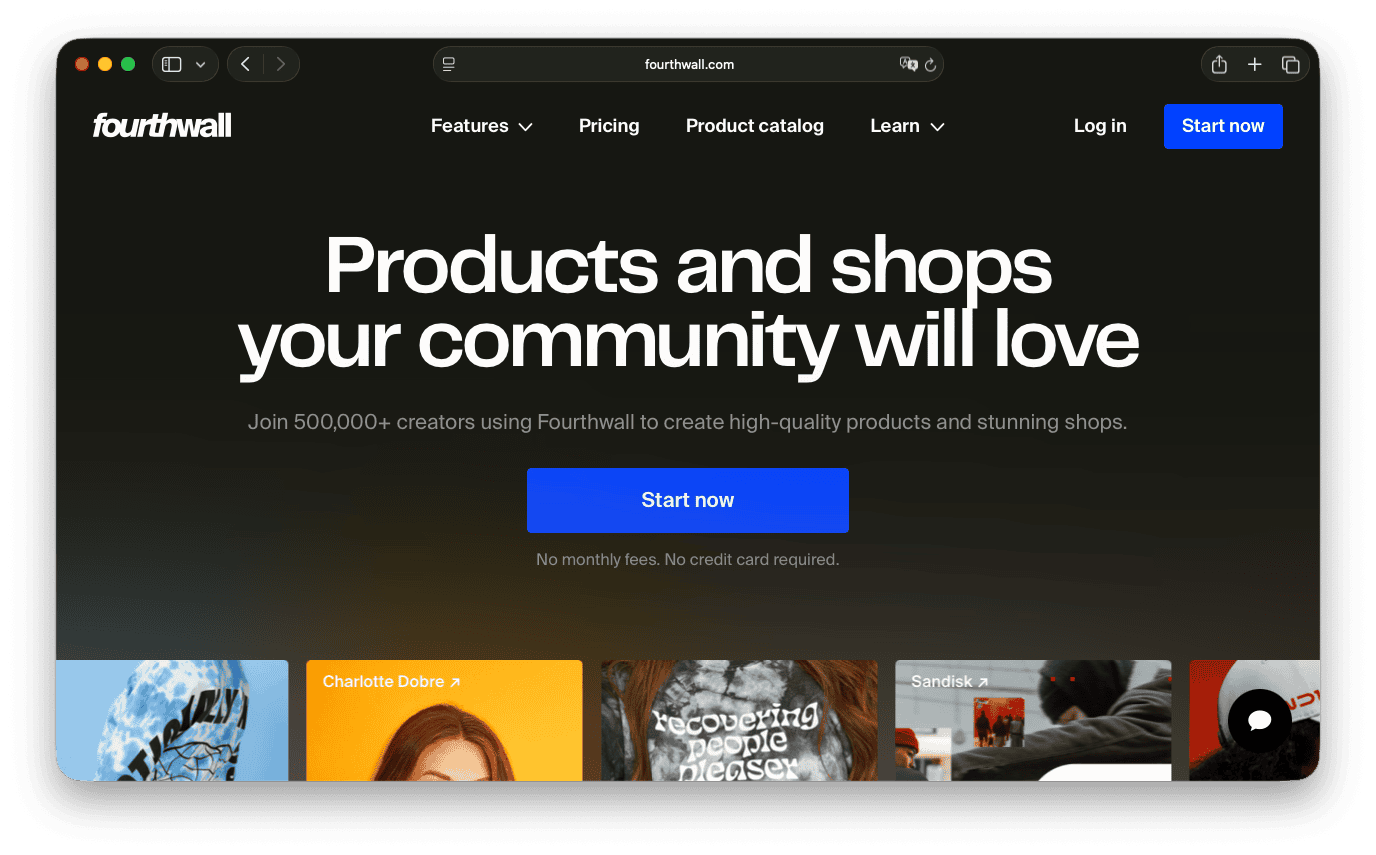
Fourthwall is an all-in-one commerce platform for creators, combining a fully branded storefront, physical and digital products, and memberships. Fourthwall is built around the full range of products creators sell today, including print-on-demand merch, which Kajabi doesn't address at all.
Content creator Naiya Taylor summed it up in her Trustpilot review:
Pros of Fourthwall
- No monthly subscription fee to start, unlike Kajabi's $179+/month floor
- Native print-on-demand merch alongside digital products, something no platform on this list combines the same way
- Fully branded storefront on your own domain, even on the Free plan
- Fourthwall acts as Merchant of Record for applicable transactions, handling relevant sales tax and VAT
- Fourthwall's support team handles end-customer support for Fourthwall-produced catalog orders
Cons of Fourthwall
- Less built-in course infrastructure (drip content, quizzes, certificates) than dedicated course platforms like Kajabi, Thinkific, or Teachable
- Automation and email marketing depend on integrations (Klaviyo, Mailchimp, Kit) rather than a native built-in funnel builder
- Digital products carry a 5% platform fee on the Free plan (0% on Pro)
A Summary of Fourthwall's Trustpilot Reviews
Across 370+ Trustpilot reviews, creators consistently praise how easy Fourthwall makes it to set up and manage a store, even for first-time sellers. Support stands out too, with reviewers describing the team as quick to respond, genuinely helpful, and professional.
Fourthwall Pricing
Fourthwall's Free plan has no monthly fee, no upfront inventory, and no contract.
For catalog products, the base cost is deducted from the retail price you set, and you keep the full margin with no extra percentage fee.
Products you source yourself carry a 0% platform fee.
Digital products carry a 5% fee on Free, which drops to 0% on the Pro plan ($19/month, or $15/month billed annually).
Memberships carry a 5% fee on both plans. US credit card transactions add a 2.9% + $0.30 payment processing fee on every plan.
Fourthwall vs Kajabi: Pricing Breakdown
Kajabi charges a flat monthly fee and takes no cut of your sales.
Fourthwall's Free plan has no monthly fee, but a 5% fee on each digital sale, while Fourthwall Pro sits in between, at $19 a month with 0% on digital products.
Here's what selling a $49 digital course costs on each, at 25 and 100 sales a month:
Fourthwall Pro is the cheapest option at both volumes, costing $160 less a month than Kajabi Basic for the same sales. That's the difference between the two plan fees, since neither charges a cut of your digital sales.
Fourthwall's Free plan works best while you're starting. Its 5% fee costs less than Kajabi's plan fee up to about 73 sales a month, and less than Pro's $19 up to about 8 sales. Past that, switching to Pro saves you money.
Kajabi's higher fee does buy things Fourthwall doesn't have built in, including email marketing, sales funnels, and deeper course tools like quizzes and certificates. If you'd otherwise pay for an email tool separately, factor that in.
If you want to sell merch alongside your courses, or don't want to file sales tax yourself, Fourthwall covers both on either plan.
2. Podia
Average customer rating: Trustpilot: 4.1 (140+ reviews)
Podia is the best alternative to Kajabi for creators launching courses, downloads, and coaching with a simple website, without the steeper price tag of platforms like Kajabi.

Podia is a course and digital-product platform built for creators who want to launch quickly without a complicated setup. It combines online courses, digital downloads, coaching sessions, and a basic website builder. Podia’s interface stays intentionally simple compared to Kajabi's broader marketing suite.
Podia now runs a three-tier plan structure, starting with Mover and moving up to Shaker and Earthquaker as you add more community spaces, storage, and integrations like Zapier and Zoom. It's a straightforward way to get a course or digital-download business online without wrestling with the deeper automation tools that come with Kajabi.
Pros of Podia
- Simpler interface than Kajabi for creators who don't need a full marketing suite
- Courses, downloads, and coaching bundled in one plan
- Community spaces included starting on the entry plan
Cons of Podia
- Mover, the entry plan, still carries a 5% transaction fee; 0% requires upgrading to Shaker
- No native support for physical products or merch
- Fewer marketing automation features than Kajabi
A Summary of Podia's Trustpilot Reviews
Across 140+ Trustpilot reviews, customers praise Podia's intuitive interface, which makes managing courses, sales pages, and digital products simple, along with a support team they describe as quick, warm, and genuinely helpful. Some reviewers, though, reported slow or unhelpful responses when they needed urgent help, such as with a locked account.
Podia Pricing
Podia's Mover plan is $49/month ($42/month billed annually) and carries a 5% transaction fee.
Shaker is $99/month ($84/month billed annually), drops the transaction fee to 0%, and adds affiliate marketing, upsells, and PayPal, Zoom, and Zapier integrations.
Earthquaker is $179/month ($150/month annually) and removes the caps on products, videos, and community spaces.
Every plan includes built-in email with a subscriber limit (100 on Mover, 500 on Shaker, 1,000 on Earthquaker), and you can pay to add more.
Stripe or PayPal processing (typically 2.9% + $0.30) applies on top.
Podia offers a 14-day free trial.
3. Circle
Average customer rating: Trustpilot: 3.9 (100+ reviews)
Circle is the best alternative to Kajabi for brands and creators who prioritize community spaces, events, courses, and branded apps.

Circle is a community platform built around spaces, live events, courses, and branded mobile apps. Unlike Kajabi, Circle makes community the center of the product, with deeper event tooling and app customization.
Creators who want to build an engaged, ongoing member community tend to find Circle's tools more purpose-built for that than Kajabi's.
Pros of Circle
- Deeper community, event, and branded-app functionality than Kajabi
- Transaction fees step down as you move up plan tiers (2% to 0.5%)
- Strong for ongoing member engagement, not just one-time course delivery
Cons of Circle
- Entry plan starts at $89/month, higher than several other alternatives on this list
- Not built as a general commerce or merch platform
- No native support for physical products
A Summary of Circle's Trustpilot Reviews
Across 100+ Trustpilot reviews, customers praise Circle's responsive, helpful support staff and a platform that's easy to use and well organized for setting up and running online communities. Some reviewers, though, found it unnecessarily hard to delete profiles or leave communities.
Circle Pricing
Circle's Professional plan is $89/month billed annually, with a 2% transaction fee.
Business is $199/month with a 1% fee, Scale is $419/month with a 1% fee, and Circle Plus is custom-priced with a 0.5% fee and custom branded mobile apps.
Circle offers a 14-day free trial and a 30-day money-back guarantee.
4. Mighty Networks
Average customer rating: Trustpilot: 3.5 (210+ reviews)
Mighty Networks is the best alternative to Kajabi for communities built around member-to-member interaction, events, and retention.

Mighty Networks focuses on peer-to-peer community, not just creator-to-audience content interactions. It's built for creators who want members to interact with each other, not only consume a course, with flat-rate pricing that doesn't scale with member count.
Compared to Kajabi's course-and-funnel focus, Mighty Networks puts more weight on ongoing community and events.
Pros of Mighty Networks
- Stronger community networking and event functionality than Kajabi
- Flat-rate pricing with unlimited members on every plan
- Native mobile community app included
Cons of Mighty Networks
- No native support for physical products or merch
- Transaction fees apply even on higher tiers (down to 0.5%, never 0%)
- Course tooling is lighter than dedicated platforms like Kajabi or Thinkific
A Summary of Mighty Networks' Trustpilot Reviews
Across 210+ Trustpilot reviews, customers describe Mighty Networks as a powerful, flexible tool for building active communities, praising its custom design options, training resources, and helpful support team. Some reviewers, though, reported unexpected renewals and difficulty canceling their subscriptions.
Mighty Networks Pricing
Mighty Networks' Launch plan is $79/month billed annually, with a 2% transaction fee.
Scale is $179/month with a 1% fee, and Growth is $354/month with a 0.5% fee.
Mighty Pro is custom-priced, keeps the 0.5% fee, and adds your own branded apps.
Every plan includes unlimited members, and the free trial lasts 14 days.
5. Gumroad
Average customer rating: Trustpilot: 1.4 (410+ reviews)
Gumroad is the best alternative to Kajabi for creators selling digital downloads, software, or simple memberships who want a low-complexity checkout.

Gumroad is built for creators who want to sell a digital file quickly, without building a storefront or setting up a course. There's no monthly subscription fee at all, which is a sharp contrast to Kajabi's $179+/month starting point, and no plan tiers to navigate.
Gumroad also acts as merchant of record for applicable sales, so it handles sales tax collection and remittance for you. It's best suited to creators who want the simplest possible path to selling a digital product without a broader course or community layer.
Pros of Gumroad
- No monthly subscription fee at any tier
- Very fast to set up for a single digital product or download
- Acts as merchant of record for applicable sales
Cons of Gumroad
- 10% + $0.50 fee on direct sales, or a flat 30% on sales through Gumroad's Discover marketplace
- No native course infrastructure (drip content, quizzes, student progress) like Kajabi
- No support for physical products or merch
A Summary of Gumroad's Trustpilot Reviews
Across 410+ Trustpilot reviews, sellers who had a good experience describe Gumroad as a dependable option with a clean layout and plenty of flexibility for selling digital products. Many reviewers, though, reported delayed or restricted payouts and slow, chatbot-led support.
Gumroad Pricing
Gumroad has no monthly subscription fee. It charges 10% + $0.50 per transaction on sales through your own profile or direct links, and a flat 30% on sales that come through its Discover marketplace.
As merchant of record, Gumroad handles sales tax collection and remittance at no extra cost.
6. Sellfy
Average customer rating: Trustpilot: 3.7 (70+ reviews)
Sellfy is the best alternative to Kajabi for creators who want a hosted store combining digital products and basic print-on-demand.

Sellfy is a website like Kajabi but built around commerce rather than courses. It bundles digital products, physical products, subscriptions, and basic print-on-demand into one relatively simple hosted store.
Every Sellfy plan carries a 0% transaction fee, so the monthly subscription is the only recurring cost to plan for. The platform is a reasonable fit for creators who want some product variety beyond pure digital downloads without taking on a full creator-commerce platform.
Pros of Sellfy
- 0% transaction fee at every plan tier
- Combines digital products, physical products, and POD in one plan
- Built-in email marketing tools
Cons of Sellfy
- No free plan; starts at $29/month
- Every plan caps annual sales (Starter tops out at $10K), and going over without upgrading can trigger a 2% overage fee
- Less course-specific tooling than Kajabi or dedicated course platforms
A Summary of Sellfy's Trustpilot Reviews
Across 70+ Trustpilot reviews, sellers praise how easy Sellfy makes it to set up a store and sell digital products, even without technical skills, along with responsive support and built-in tools like email marketing and coupon codes. Some reviewers, though, reported that support was hard to reach when orders or shipments went wrong.
Sellfy Pricing
Sellfy charges a 0% transaction fee on every plan, but each plan caps your annual sales.
- Starter is $29/month ($22/month billed annually) for up to $10K in sales per year.
- Business is $79/month ($59/month billed annually) for up to $50K and adds upselling, cart abandonment, and affiliate marketing.
- Premium is $159/month ($119/month billed annually) for up to $200K.
If you pass your cap without upgrading, Sellfy may charge a 2% overage fee on the extra revenue.
PayPal or Stripe processing (typically 2.9% + $0.30) applies on top. Sellfy offers a 14-day free trial.
7. Thinkific
Average customer rating: Trustpilot: 1.8 (860+ reviews)
Thinkific is the best alternative to Kajabi for course creators who want dedicated course tools, quizzes, and a community at a lower entry price.

Thinkific is an online course platform that lets creators build courses, run a community, and sell digital downloads, coaching, and memberships from a site on their own domain. Every plan includes unlimited courses, a drag-and-drop course builder, drip scheduling, quizzes, and email automation, so the core teaching tools aren't locked behind the top tier.
Thinkific focuses on the learning experience with features like completion certificates, assignments, live cohorts, and payment plans unlocked on the Start plan.
If your business is mainly courses and you don't need Kajabi's full sales pipeline, Thinkific gives you the teaching infrastructure for less.
Pros of Thinkific
- Every plan includes a drag-and-drop course builder with quizzes, drip scheduling, and in-course discussions
- You can run Thinkific alongside your existing website and use it only for courses and community
- Community, email automation, and landing pages are built in, so you need fewer outside tools
Cons of Thinkific
- Basic keeps Thinkific branding on your site and allows one admin and five digital downloads
- A branded mobile app is a $199/month add-on, and SCORM support is only on the custom-priced Plus plan
- Built for digital learning products, so selling merch means adding a second platform
A Summary of Thinkific's Trustpilot Reviews
Across 860+ Trustpilot reviews, creators who had a good experience praise Thinkific for making it easy to launch an online course, along with clear training videos and a responsive support team. Many recent reviewers, though, reported trouble canceling trials and subscriptions, unexpected charges, and slow support.
Thinkific Pricing
Thinkific's Basic plan is $54/month ($40/month billed annually) and includes unlimited courses, one community, and up to five digital downloads.
Start is $109/month ($82/month billed annually) and adds certificates, assignments, live cohorts, memberships, and payment plans.
Grow is $219/month ($164/month billed annually) and removes Thinkific branding, allows three communities, and adds API access.
Thinkific Plus is custom-priced.
Thinkific Payments processing runs at about 2.9%. Using Stripe or PayPal instead adds a third-party gateway fee that varies by plan.
Every plan starts with a 30-day free trial.
8. Teachable
Average customer rating: Trustpilot: 3.3 (1,100+ reviews)
Teachable is the best alternative to Kajabi for course creators and coaches who want built-in checkout and sales tax handling without paying for a full marketing suite.

Teachable lets you sell online courses, coaching, digital downloads, and memberships from your own school site. Checkout, upsells, abandoned-cart emails, and iOS and Android student apps come with every plan. Teachable also handles U.S. sales tax, VAT, and GST at checkout.
Before you sign up, understand the product limit. Each published course, coaching offer, or digital download counts as one product, and plans cap you at 5, 10, or 50, but memberships, bundles, and unpublished drafts don't count toward the limit. That's plenty for a creator with one flagship course. A growing library, though, can push you up a tier faster than your revenue does.
The other number to watch is the Starter plan's 7.5% transaction fee. Once your sales are steady, that fee usually makes Builder the cheaper plan.
Pros of Teachable
- iOS and Android student apps on every plan, so learners can take courses on their phones
- Sales tax, VAT, and GST handling built into checkout
- AI course creation, upsells, and abandoned-cart recovery included from Starter
Cons of Teachable
- Product caps of 5, 10, or 50 limit how many courses and downloads you can publish
- Course certificates, extra admin seats, and removing Teachable branding all require the Growth plan
- No physical products or merch, so pairing courses with branded products means a second platform
A Summary of Teachable's Trustpilot Reviews
Across 1,100+ Trustpilot reviews, creators find Teachable easy to use and appreciate its range of tools and flexibility for building and scaling an online school. Some reviewers, though, said support can take days to respond and that reaching a real person past the chatbot is difficult.
Teachable Pricing
Teachable's Starter plan is $39/month ($29/month billed annually) with 5 products, 1 admin, and a 7.5% transaction fee.
Builder is $89/month ($69/month billed annually) with 10 products, a 0% transaction fee, and an affiliate program.
Growth is $189/month ($139/month billed annually) with 50 products, 5 admin seats, course certificates, and no Teachable branding.
Payment processing adds 2.9% + $0.30 on U.S. card sales and 3.9% + $0.30 on international cards.
Every plan includes a 7-day free trial and a 30-day money-back guarantee.
9. LearnWorlds
Average customer rating: Trustpilot: 4.8 (420+ reviews)
LearnWorlds is the best alternative to Kajabi for course creators who want interactive video, assessments, and a white-label academy.

LearnWorlds is an online course platform that includes interactive video, an assessment builder, certificates, SCORM support, and a built-in community. It also covers the business side with a website builder, affiliate tools, subscriptions, and email. LearnWorlds serves both independent creators and companies running customer or employee training.
The catch is how much of that sits above the entry plan. Starter is priced low, but it:
- Charges $5 per paid enrollment
- Caps you at 1,000 active learners a month
- Leaves out free courses, certificates, interactive video, landing pages, and subscriptions
Pro Trainer is where LearnWorlds starts to compete with Kajabi, and full white-label branding only comes with Learning Center. Make sure you budget for the tier that has the features you're switching for, not the headline price.
Pros of LearnWorlds
- Interactive video and a flexible assessment builder on Pro Trainer and above
- Unlimited video hosting and a built-in community on every plan
- Pro Trainer drops enrollment fees and adds certificates, subscriptions, and unlimited learning paths
Cons of LearnWorlds
- Starter adds $5 per paid enrollment and excludes interactive video, certificates, and free courses
- Full white-label branding requires Learning Center ($249/month billed annually)
- No physical products or merch
A Summary of LearnWorlds' Trustpilot Reviews
Across 420+ Trustpilot reviews, customers praise LearnWorlds' responsive, knowledgeable support team and an intuitive platform packed with features for building and sharing online courses. Some reviewers, though, found more complex tasks, like managing large video libraries or migrating existing data, harder to handle.
LearnWorlds Pricing
LearnWorlds' Starter plan is $29/month ($24 billed annually), plus $5 per paid enrollment, with 1,000 monthly active learners and 1 admin.
Pro Trainer is $99/month ($79 billed annually) with no enrollment fees, 2,000 active learners, and 5 admins.
Learning Center is $299/month ($249 billed annually) and adds full white-label branding and 25 admins. Corporate plans are custom-priced.
A branded mobile app is a paid add-on, listed prices exclude VAT, and your payment gateway (Stripe or PayPal) charges its own processing fees.
Every plan starts with a 30-day free trial.
How to Choose the Right Kajabi Alternative
Most creators switch from Kajabi for one specific reason, like the $179 monthly minimum, the lack of merch, or more automation than they need. Start with that reason, then find the row below that matches what you actually sell.
If selling merch alongside your courses and digital products is part of your plan, start with Fourthwall and add the course or community tool that fits how you teach.
FAQ
Kajabi is worth its $179 a month starting price mainly for established educators who will use its built-in email marketing, sales funnels, quizzes, and certificates. Creators running a smaller course business often find Kajabi's automation is more than they need, and Fourthwall Pro costs $160 less a month than Kajabi Basic for the same digital course sales.
Fourthwall and Gumroad are the cheapest Kajabi alternatives because neither charges a monthly subscription fee, compared with Kajabi's $ 179-a-month Basic plan. Fourthwall takes a 5% fee on digital products on its Free plan, while Gumroad charges 10% + $0.50 per direct sale. Among paid plans, LearnWorlds and Sellfy both start at $29 a month.
Kajabi isn't built for merch or physical products, so creators who want to pair courses with branded apparel usually add a second platform. Fourthwall combines print-on-demand merch with digital products and memberships in one storefront, and Sellfy bundles digital products, physical products, and basic print-on-demand in one hosted store.
Thinkific and Teachable both cost less than Kajabi, with Thinkific starting at $54 a month and Teachable at $39 a month. Thinkific includes unlimited courses, quizzes, and drip scheduling on every plan. Teachable adds iOS and Android student apps and sales tax handling on every plan, but caps published products at 5, 10, or 50 and charges a 7.5% transaction fee on Starter.
Circle and Mighty Networks are the strongest Kajabi alternatives for community, since both put spaces, events, and member engagement at the center of the product. Circle starts at $89 a month billed annually with deeper event tools and branded apps, and Mighty Networks starts at $79 a month billed annually, with unlimited members and a focus on member-to-member interaction.
Richard is Head of Organic Growth at Fourthwall, with 14+ years of experience in the creator economy and ecommerce. He’s built businesses across the spectrum—from print-on-demand stores to custom cut-and-sew clothing lines, as well as selling digital products. He helps creators navigate merch strategy and build sustainable businesses.


You might also like

Printful vs. Printify for Creators in 2026 (and When Fourthwall Fits Better)

How to Create a Digital Product and Sell It

8 Best TeePublic Alternatives for Artists in 2026

9 Best Printify Alternatives for Print-on-Demand in 2026

8 Best Spring (Teespring) Alternatives for Creators After Its Shutdown

30 Best Print on Demand Products for Creators in 2026 (From Tees to Plushies)

What to Sell Online: How to Find a Product People Want

8 Best Spreadshirt Alternatives for Print-on-Demand in 2026

7 Best Sellfy Alternatives for Creators and Brands in 2026

Keep up with the latest from Fourthwall
New features, product updates, trend breakdowns, and creator stories — straight to your inbox.