
9 Best Redbubble Alternatives for Print-on-Demand Creators in 2026
Compare fees, features, and fit across 9 Redbubble alternatives to find the platform that matches how you sell.


The best Redbubble alternatives in 2026 are Fourthwall, TeePublic, Amazon Merch on Demand, Zazzle, Printify, Tapstitch, Spreadshirt, Gelato, and Sellfy. Fourthwall is the top pick for creators who want a branded storefront, merch, memberships, and digital products in one place, with Fourthwall acting as Merchant of Record to handle sales tax and VAT. Creators switch from Redbubble because of its 50% Standard-tier platform fee and limited storefront control.
Redbubble is one of the most recognized names in print-on-demand.
Creators upload artwork, it lands on more than 70 products, and Redbubble handles production, shipping, and customer service in exchange for a cut.
Redbubble is the default entry point for a whole generation of independent artists because of the built-in marketplace and zero-setup workflow.
However, creators start looking for Redbubble alternatives for four recurring reasons:
- Margin: Redbubble now applies a 50% platform fee on Standard-tier monthly earnings, dropping to 20% on Premium and 0% on Pro, and adds a 50% excess markup fee on the portion of any markup above 20% for Standard and Premium accounts.
- Brand control: Every sale happens inside Redbubble's storefront, not yours. You don't own the customer relationship, the email list, or the checkout experience.
- Reach vs. control: Some creators would rather trade marketplace traffic for a storefront they design, price, and grow themselves.
- Account risk: Takedowns, tier reclassifications, and marketplace policy changes can move earnings overnight, and there's no direct-to-fan channel to fall back on.
In this guide, we'll explore the best alternatives to Redbubble for print-on-demand creators, matched to the reason you're leaving.
Redbubble Alternatives at a Glance
1. Fourthwall
Average customer rating: Trustpilot: 4.3 (350+ reviews)
Fourthwall is the best Redbubble alternative for print-on-demand creators who want to own their storefront instead of renting a page inside a marketplace.
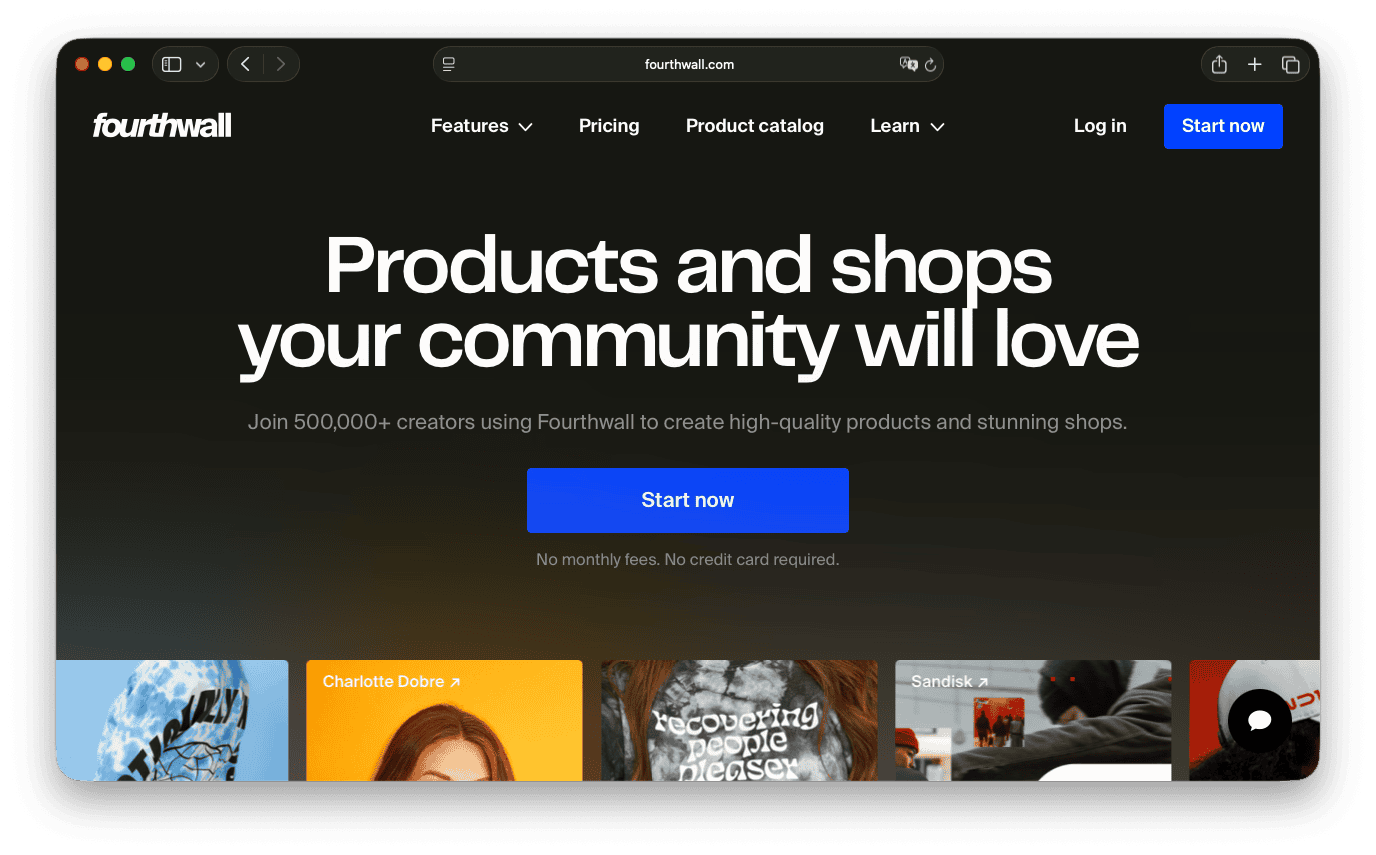
Fourthwall is an all-in-one commerce platform built for creators. You get a fully branded online shop with your own domain, catalog products that Fourthwall produces and ships on demand, and a checkout that looks like part of your brand rather than a marketplace listing.
The product catalog includes hundreds of customizable items across apparel, accessories, home goods, and drinkware, with production methods spanning DTG, DTFx, embroidery, screen printing, sublimation, and UV printing depending on the item.
Fourthwall serves as the Merchant of Record on eligible transactions, meaning sales tax and VAT are calculated, collected, and remitted on the creator's behalf, while Fourthwall's support team fields end-customer inquiries for orders produced through Fourthwall's own catalog.
For a print-on-demand creator considering Fourthwall alongside other tools, one reviewer put it this way:
Beyond physical merch, you can layer in digital products, memberships, and donations from the same dashboard, so a Redbubble-style POD business can grow into a full creator business without swapping platforms.
Pros of Fourthwall
- Branded storefront with your own domain and full control over layout, style, and checkout
- Merchant of Record handles sales tax and VAT for applicable platform transactions
- Hundreds of catalog products with multiple print methods, plus bespoke products at low MOQs
- Multiple revenue streams in one place: merch, digital products, memberships, and tips
Cons of Fourthwall
- No built-in marketplace, so you bring your own audience. Organic discovery works differently than in a shared marketplace catalog
- Built for on-demand rather than high-volume bulk, so large wholesale runs aren't the core use case
A Summary of Fourthwall's Trustpilot Reviews
Across 350+ reviews, customers frequently describe the service as reliable and easy to use for building a storefront and customizing products, with support singled out as fast and helpful for everyday questions.
Fourthwall Pricing
Fourthwall is free to use, with no monthly fee on the Free plan and no charge until you make a sale. Catalog products carry a flat base cost deducted from the retail price you set, so there's no separate percentage platform fee on physical merch. Card processing runs at 2.9% + $0.30 per US transaction.
Fourthwall has two plans:
- Free ($0/month): the full toolkit, including your storefront, hundreds of catalog products, memberships, digital products, and donations. Digital products carry a 5% platform fee on Free, memberships a 5% fee, and donations 0%.
- Pro ($19/month, or $180/year): everything in Free, plus a 0% platform fee on digital products, higher product limits, priority support, monthly sample credit, and an included .store domain.
Fourthwall vs Redbubble: Pricing Breakdown
Both platforms handle production, payments, and customer service, so the difference is how much of each sale you keep. Redbubble's base price for a tee is higher, and on Standard and Premium accounts, its fees come out of your margin on top of that.
Here's what you keep selling a t-shirt at $25 on each platform, at 25 and 100 orders a month:
At the same $25 price, you keep about $12 per shirt on Fourthwall, compared with $2 on a Standard Redbubble account and $3.50 on Premium. That's about $255 more a month at 25 orders on Standard, and around $870 more at 100 orders, even after Redbubble's fee cap kicks in.
Redbubble's advantage is the marketplace. Shoppers can find your designs there without you sending them. If you already have an audience to bring, Fourthwall lets you keep far more of each sale, and you own the customer relationship that Redbubble keeps.
2. TeePublic
Average customer rating: Trustpilot: 4.4 (600K+ reviews)
TeePublic is the best Redbubble alternative for artists who want a marketplace with predictable per-sale royalties and near-zero setup.

TeePublic is a marketplace print-on-demand platform. It’s simple to use: you upload designs, and TeePublic applies them to a catalog of tees, hoodies, stickers, art prints, phone cases, and other products.
The platform sets the retail price and pays you a fixed dollar royalty per sale, so your earnings per item don't depend on markup math.
TeePublic pays a flat per-sale royalty that changes with frequent sitewide sales, plus a tiered system (Apprentice vs. Artisan) where the higher tier earns more and gets better search visibility. It feels more predictable than Redbubble's 50% Standard-tier fee, but in practice sales pull the effective royalty down.
Pros of Teepublic
- Fixed dollar royalty per sale on each product category, so earnings math is simple
- No signup, listing, or monthly fees: TeePublic earns from the gap between retail price and royalty
- Built-in marketplace audience with existing organic traffic
Cons of Teepublic
- You don't set retail prices: TeePublic controls pricing and runs frequent sitewide discounts, which pull the effective per-sale royalty down
- Two-tier artist system means new Apprentice-tier accounts earn roughly half of Artisan rates and don't appear in on-site search
- No customer relationship or email capture
A Summary of TeePublic's Trustpilot Reviews
Across 600K+ reviews, customers praise product quality, plus fast delivery and a wide selection of art/designs to choose from. A smaller share of reviewers flagged quality control issues (blurry prints, small holes), unexpected color variations, and occasional delivery mishaps like packages left in public areas.
Teepublic Pricing
TeePublic pays a fixed dollar royalty per item, not a percentage. Per the TeePublic earnings guide:
- Artisan tier: $4.00 on a regular-price t-shirt ($2.00 on sale); mugs, stickers, and prints earn less
- Apprentice tier: earns less on apparel (e.g., $3.00/$1.00 on a t-shirt), but matches Artisan on mugs, stickers, and prints
3. Amazon Merch on Demand
Amazon Merch on Demand is the best Redbubble alternative for designers who want Amazon-scale distribution without running their own store.

Amazon Merch on Demand is Amazon's application-based royalty program for print-on-demand designs, requiring account approval before you can start selling.
You upload artwork, choose the products it applies to (t-shirts, hoodies, sweatshirts, etc.), and Amazon handles listing, production, shipping, and returns.
Your designs live on Amazon's marketplace, which means Prime-eligible fulfillment and the reach of the largest ecommerce site in the US.
But you don’t have control. Amazon sets what products exist and what they cost to produce. In June 2026, they introduced a three-tier royalty model based on how much of your traffic you drive yourself.
Sellers who rely solely on Amazon's organic search sit in the Creator tier and earn the standard royalty rate, while those who drive at least 15% or 35% of monthly sales from external traffic qualify for Plus (2× Creator) and Premium (2.16× Creator) tiers, respectively.
Account tiers cap how many designs you can have live until you upgrade through sales performance.
Pros of Amazon Merch on Demand
- Amazon-scale traffic and Prime fulfillment on every eligible design
- No upfront cost or subscription: Amazon handles production and shipping
- Predictable per-sale royalty once your tier is set
- Zero customer service work: Amazon handles returns and support
Cons of Amazon Merch on Demand
- Invite-based approval and tier caps on how many live designs you can have
- The default Creator tier pays roughly half the old flat royalty on organic-only sales, so you either drive external traffic or accept a lower royalty
- Amazon owns the customer relationship, so you can't build a direct audience through the platform
What Amazon Merch on Demand Sellers Say About It on Reddit
Across two Reddit threads, sellers report a wide range of earnings on Amazon Merch on Demand, from a few dollars a month to several thousand for veterans with early niche footholds, but most agree the platform has gotten harder due to saturation, copycat designs, and rising ad costs, with real income typically taking years to build. (sources: r/AmazonMerch, r/Amazon_Influencer)
Amazon Merch on Demand Pricing
Amazon Merch on Demand is free to join once you're approved, with no subscription fee. Amazon pays a per-sale royalty calculated as list price minus production, fulfillment, and other costs, multiplied by your tier rate.
On a $19.99 standard t-shirt, Amazon publishes:
- Creator tier: ~$2.44 royalty
- Plus tier: ~$4.88 royalty (requires 15%+ external traffic and 10+ US monthly sales)
- Premium tier: ~$5.27 royalty (requires 35%+ external traffic and 10+ US monthly sales)
4. Zazzle
Average customer rating: Trustpilot: 4.4 (29K+ reviews)
Zazzle is the best Redbubble alternative for designers selling customizable, event-driven, and gift-oriented products.

Zazzle is a marketplace print-on-demand platform with deep personalization where customers edit designs directly in the browser before ordering. That's why Zazzle heavily focuses on weddings, invitations, stationery, party supplies, and gifts, categories where the buyer expects to add names, dates, and colors before checkout.
Pros of Zazzle
- Real-time personalization tools that most POD platforms don't offer
- Large built-in marketplace with a strong wedding, stationery, and gift buyer base
- Seller-set royalty
- Well-suited to event-driven and gift-oriented products
Cons of Zazzle
- Marketing Royalty Fees of 35–50% of gross royalty apply on sales driven by Zazzle marketing or Ambassador referrals
- 5% Excess Royalty Fee on gross royalty when you set your rate above 10%
- Limited branding control: you can't design a store around your brand outside Zazzle's marketplace template
A Summary of Zazzle's Trustpilot Reviews
Across 29K+ reviews, customers are happy with the material quality, the artistry that looks great on the finished products, and an easy, user-friendly design/ordering process. On the downside, some reviewers ran into delivery delays (including labels created but shipments stalled) and minor damage or imperfections on arrival.
Zazzle Pricing
Zazzle is free to join, with no listing fee or monthly subscription.
You set your own royalty rate: up to 50% on physical products, up to 5% on Zazzle Heart Products, and 5% to 99% on digital instant downloads. Additionally, you pay:
- 5% Excess Royalty Fee when your rate exceeds 10%
- Marketing Royalty Fee of 35–50% of gross royalty (by category), deducted on sales driven by Zazzle's marketing or Ambassador referrals
5. Printify
Average customer rating: Trustpilot: 4.5 (7.5K+ reviews)
Printify is the best Redbubble alternative for sellers who want a large product catalog and cost flexibility across multiple print providers.

Printify is a print-on-demand network connecting you to 140+ independent print providers across 1,300+ products, letting you compare providers on base cost, shipping, and print method for the same item.
It doesn't sell directly to customers. You connect it to your own storefront (Shopify, Etsy, Wix, TikTok Shop, etc.), and Printify handles production and shipping once an order comes in.
That makes it a strong fit for creators leaving Redbubble who want their own site rather than a marketplace listing and are comfortable choosing providers themselves.
Pros of Printify
- Large product catalog with more than 1,300 items across apparel, home, and accessories
- 140+ print providers so you can compare price, quality, and shipping for the same product
- Broad integrations with Shopify, Etsy, TikTok Shop, WooCommerce, and other channels
- No monthly fee on the Free plan; you only pay base cost and shipping per order
Cons of Printify
- No built-in marketplace or storefront: you need a store on another platform
- Quality and shipping vary by provider, so choosing (and re-testing) providers is part of the workflow
A Summary of Printify's Trustpilot Reviews
Across 7.5K reviews, customers highlight an easy-to-navigate platform with smooth store integrations, intuitive product creation, strong print quality, and responsive customer service. A smaller group of reviewers pushed back on product quality, and some also reported shipping delays paired with unhelpful support in resolving them.
Printify Pricing
Printify is free to use, and you pay only the product base cost plus shipping per order.
Premium (from $24.99/month billed annually, or $39/month billed monthly) unlocks up to 33% discount on new products, 10 stores per account, 1:1 mentorship through Sellers Club PRO, and order management via Printify Connect.
6. Tapstitch
Average customer rating: Trustpilot: 4.3 (480+ reviews)
Tapstitch is the best Redbubble alternative for print-on-demand creators building a premium apparel or streetwear brand.

Tapstitch is a print-on-demand platform focused on apparel. Instead of a broad catalog spanning stickers, mugs, and home goods, the platform leans into heavyweight cotton tees, high-GSM hoodies, and modern streetwear cuts intended for higher retail price points.
Tapstitch owns its manufacturing, giving it tighter control over blank quality and print consistency than fulfillment networks that route orders to third-party providers.
It applies designs using direct-to-garment (DTG) and direct-to-film (DTF) printing. Tapstitch doesn't run a marketplace or a hosted storefront of its own, so you'll pair it with a store platform.
Pros of Tapstitch
- Fashion-grade apparel blanks built for higher retail price points
- Owned manufacturing rather than a third-party provider network
- No monthly fee and no order minimums: you pay per order
- Custom neck labels available for a per-unit fee, and DTG/DTF printing with multiple placements
Cons of Tapstitch
- Apparel only: no mugs, stickers, phone cases, or home goods
- Limited print methods (DTG and DTF), so no embroidery, sublimation, or all-over print
- International shipping can be slow on some routes
A Summary of Tapstitch's Trustpilot Reviews
Across 480+ reviews, customers are happy with comfortable fabric, with clean and vibrant custom prints, plus an easy-to-use design tool that make the creation process smooth and fast. A smaller number of reviewers had complaints about sizing running smaller than expected, along with occasional delivery delays and difficulty getting updates on missing orders.
Tapstitch Pricing
Tapstitch charges no subscription or setup fee. You pay per order for the base item, print charges, and shipping, with no order minimums, so costs scale directly with sales. Shipping is a base rate for the first item plus a smaller fee per additional item in the same order.
7. Spreadshirt
Average customer rating: Trustpilot: 3.9 (16K+ reviews)
Spreadshirt is the best Redbubble alternative for designers who want both marketplace exposure and a free branded storefront.

Spreadshirt (parent company Spread Group) offers three ways to sell:
- Marketplace: Spreadshirt sets the retail price; you earn a fixed commission per product category and country
- Spreadshop: a free branded storefront where you set the retail price and keep the full margin, with Spreadshirt handling fulfillment and customer service
- Spreadconnect: a free backend fulfillment plugin for your own site (Shopify, Etsy, WooCommerce), where you buy at wholesale cost, set your own retail price, and handle branding and customer service yourself
Pros of Spreadshirt
- You set your own markup on Spreadshop and Spreadconnect while Spreadshirt handles production and fulfillment
- US and EU production facilities for regional shipping
- All three channels are free to use, with no subscription or account fees
Cons of Spreadshirt
- Marketplace commissions are fixed per product and can be lower than a self-set markup on Spreadshop or Spreadconnect for the same item
- Spreadshop branding is limited compared with a full ecommerce platform
- Marketplace customer data isn't fully accessible to designers, so you don't own the buyer relationship there
A Summary of Spreadshirt's Trustpilot Reviews
Across 16K+ reviews, customers highlight vibrant colors, sharp prints, and overall product quality, along with a simple ordering process and an easy-to-navigate website with on-time deliveries. Some reviewers reported delayed shipments, missing tracking updates, and unresponsive support.
Spreadshirt Pricing
Spreadshop and Spreadconnect are both free to set up and operate, with no subscription or account fees.
- Spreadshop: You set your own markup and keep the full difference above base cost
- Spreadconnect: You're invoiced for the product's wholesale cost as soon as an order comes in from your own site, paying upfront before your customers settle payment to you
- Marketplace: Spreadshirt sets the final retail price and pays a fixed design commission per item, rather than a percentage of sale price.
8. Gelato
Average customer rating: Trustpilot: 4.3 (3K+ reviews)
Gelato is the best Redbubble alternative for sellers who already run a store and want a global fulfillment backend instead of a marketplace.

Gelato is a global print-on-demand fulfillment platform. The platform automatically routes orders placed on your existing store (Shopify, Etsy, Wix, WooCommerce, Squarespace, and others) to the closest partner facility in its network across more than 30 countries.
Gelato covers apparel, wall art, drinkware, home goods, and accessories, with production methods including DTG, embroidery, and dye-sublimation.
It doesn't host a storefront or a marketplace of its own, so it's a fit if you're leaving Redbubble for a store you already run, not if you're looking for built-in discovery.
Pros of Gelato
- Local production across 30+ countries for faster international shipping
- Consistent print standards across partner facilities
- Broad integrations with major store platforms
- Free plan with no monthly cost; pay only base cost and shipping per order
Cons of Gelato
- No built-in storefront or marketplace: you connect Gelato to a store you already have
- Product catalog is smaller than some large POD marketplaces
A Summary of Gelato's Trustpilot Reviews
Across 3K+ reviews, customers point out fast production turnaround, an easy product creation and signup flow, and responsive customer support agents who resolve issues clearly. Some reviewers report problems with damaged or crushed posters due to inadequate packaging.
Gelato Pricing
Gelato is free to join, with no cost until an order comes in. You only pay the product base cost plus shipping at that point. Sellers wanting lower per-item pricing can opt into Gelato+ at $29.99/month (or $19.99/month billed annually), which adds product discounts and extra tools. A custom enterprise tier is available for high-volume sellers.
9. Sellfy
Average customer rating: Trustpilot: 3.7 (70+ reviews)
Sellfy is the best Redbubble alternative for creators who want a single hosted store combining POD merch, digital products, and subscriptions.

Sellfy is a creator storefront with print-on-demand built in. You get a hosted store you can theme and customize, plus native support for digital downloads, subscriptions, and POD apparel.
A Redbubble artist who wants to add e-books, presets, or a paid newsletter can do so in the same dashboard as merch.
Sellfy is subscription-first, so the math tilts in your favor once you're selling enough that a flat monthly fee costs less than a percentage cut on the same revenue. Below that break-even, a free-to-start alternative can be cheaper on paper.
Pros of Sellfy
- Hosted storefront for digital, physical, and subscription products in one place
- Print-on-demand built in: no need to stitch multiple tools together
- Store builder with themes and a straightforward setup workflow
Cons of Sellfy
- No free plan: only a 14-day trial
- Annual sales caps per plan with a 2% surcharge on revenue above the cap
- Fewer integrations than a platform built around a large app ecosystem
A Summary of Sellfy's Trustpilot Reviews
Across 70+ reviews, customers highlight how easy and intuitive the platform is to set up and manage, even for non-technical users, along with helpful, responsive support staff. Some reviewers found the platform too expensive, and others noted limits on customization that weren't clear until after signing up
Sellfy Pricing
Sellfy charges a flat monthly subscription and takes 0% transaction fees on all paid plans. Each plan has an annual sales cap ($10,000 on Starter, $50,000 on Business, $200,000 on Premium), and sellers exceeding $200k are directed to contact Sellfy for custom high-volume pricing. Standard payment-processor fees (Stripe or PayPal) still apply on top of the subscription.
How to Choose the Right Redbubble Alternative Based on the Reason You’re Leaving
The fastest way to choose a Redbubble alternative is to match your situation to a scenario rather than compare feature grids.
If you're leaving Redbubble because you want the customer relationship, the email list, and a shop that looks like your brand, Fourthwall is the only alternative built around that reader. It handles production, taxes, and end-customer support without stitching four tools together.
Set up a branded store, list your POD catalog, layer in memberships or digital products when you're ready, and keep the audience you already have.
FAQ
Redbubble's Standard-tier accounts pay a 50% platform fee on monthly earnings, dropping to 20% on Premium and 0% on Pro, and Standard and Premium accounts also pay a 50% Excess Markup Fee on any markup above 20%. A Standard-tier artist who sets a 20% markup on a $20 T-shirt ($4 markup) takes home $2 after the 50% platform fee, per the Redbubble Help Center. Redbubble caps the total monthly platform fee at $150.
Fourthwall works well as a Redbubble alternative for creators with an existing audience, because it pairs a branded custom storefront with print-on-demand merch, memberships, and digital products on one platform, with no monthly fee. Redbubble is a shared marketplace built around search traffic inside its own catalog, so artists who already drive fans from social channels typically keep more revenue on a platform they own rather than pushing traffic into Redbubble's marketplace.
Fourthwall's Free plan, TeePublic, Amazon Merch on Demand, Zazzle, and Spreadshirt all have no upfront cost and no monthly fee, making them the cheapest Redbubble alternatives for beginners. The trade-off is where the fees land: marketplaces like TeePublic and Amazon Merch pay a fixed base cost per item and let the seller keep the markup, while Fourthwall charges 0% on physical merch margin (only payment processing) and a 5% platform fee on memberships and digital products.
TeePublic is often preferred by T-shirt-focused artists because it specializes in apparel with a narrower catalog and higher effective per-tee earnings, while Redbubble spreads the same designs across 70+ product types including stickers, home decor, and phone cases. TeePublic pays a flat cut on each T-shirt sale (roughly $4 on a standard tee) and runs frequent site-wide sales that can lift volume for popular designs. Artists who care mainly about tees usually see stronger per-sale earnings on TeePublic.
Redbubble typically ships within 3 to 5 business days of production, with total delivery of 5 to 12 business days for US customers depending on the fulfillment center. Amazon Merch on Demand ships within 2 to 4 business days using Amazon's own logistics, Printify's US network can hit 2 to 5 business days total for domestic orders, and Gelato routes production to the printer nearest the buyer to shorten cross-border transit across 32 countries.
Richard is Head of Organic Growth at Fourthwall, with 14+ years of experience in the creator economy and ecommerce. He’s built businesses across the spectrum—from print-on-demand stores to custom cut-and-sew clothing lines, as well as selling digital products. He helps creators navigate merch strategy and build sustainable businesses.


You might also like
.webp)
Top 8 Wix Alternatives for Creators Building an Online Store in 2026

How to Create and Sell Print on Demand Journals and Notebooks

9 Gumroad Alternatives for Digital Creators in 2026

10 Best Stan Store Alternatives for Creators in 2026

9 Best Patreon Alternatives for Creators in 2026

20 Sustainable Swag Ideas for Events and Giveaways

8 Best Gelato Alternatives for Print-on-Demand in 2026

TikTok Affiliate Marketing: How It Works and How to Make Money

The Top Celebrity Clothing Brands and Why They Succeeded


Keep up with the latest from Fourthwall
New features, product updates, trend breakdowns, and creator stories — straight to your inbox.