
8 Best Spreadshirt Alternatives for Print-on-Demand in 2026
Compare fees, features, and fit across 8 Spreadshirt alternatives to find the platform that matches how you sell.


Spreadshirt alternatives worth considering in 2026 include Fourthwall, Printful, Redbubble, Printify, Gelato, Tapstitch, TeePublic, and Zazzle. Fourthwall charges no monthly fee to start and pairs a branded storefront with native print-on-demand merch, memberships, and digital products, versus Spreadshirt's marketplace model, where the margin is whatever you can add on top of its set production cost.
Spreadshirt appeals to creators because it's simple. You upload a design and set a price, and Spreadshirt handles printing and shipping with no upfront cost. Shoppers already browsing its marketplace can discover your new designs, and Spreadshirt fulfills orders across the US and Europe.
But the marketplace-first model comes with a few significant downsides. Spreadshirt sets the base production cost, so your margin is only what you add on top, and it shrinks as you compete with other sellers on price. You also don't own the customer relationship the way you would with your own storefront, and Spreadshirt offers limited tools for capturing emails, running campaigns, or building repeat business.
In this guide, we'll explore some of the best Spreadshirt alternatives to help you find a print-on-demand platform that fits how you want to grow your creator business.
Spreadshirt Alternatives at a Glance
1. Fourthwall
Average customer rating: Trustpilot: 4.2 (370+ reviews)
Fourthwall is the best Spreadshirt alternative for creators who want a branded store with merch, memberships, and digital products in one place.
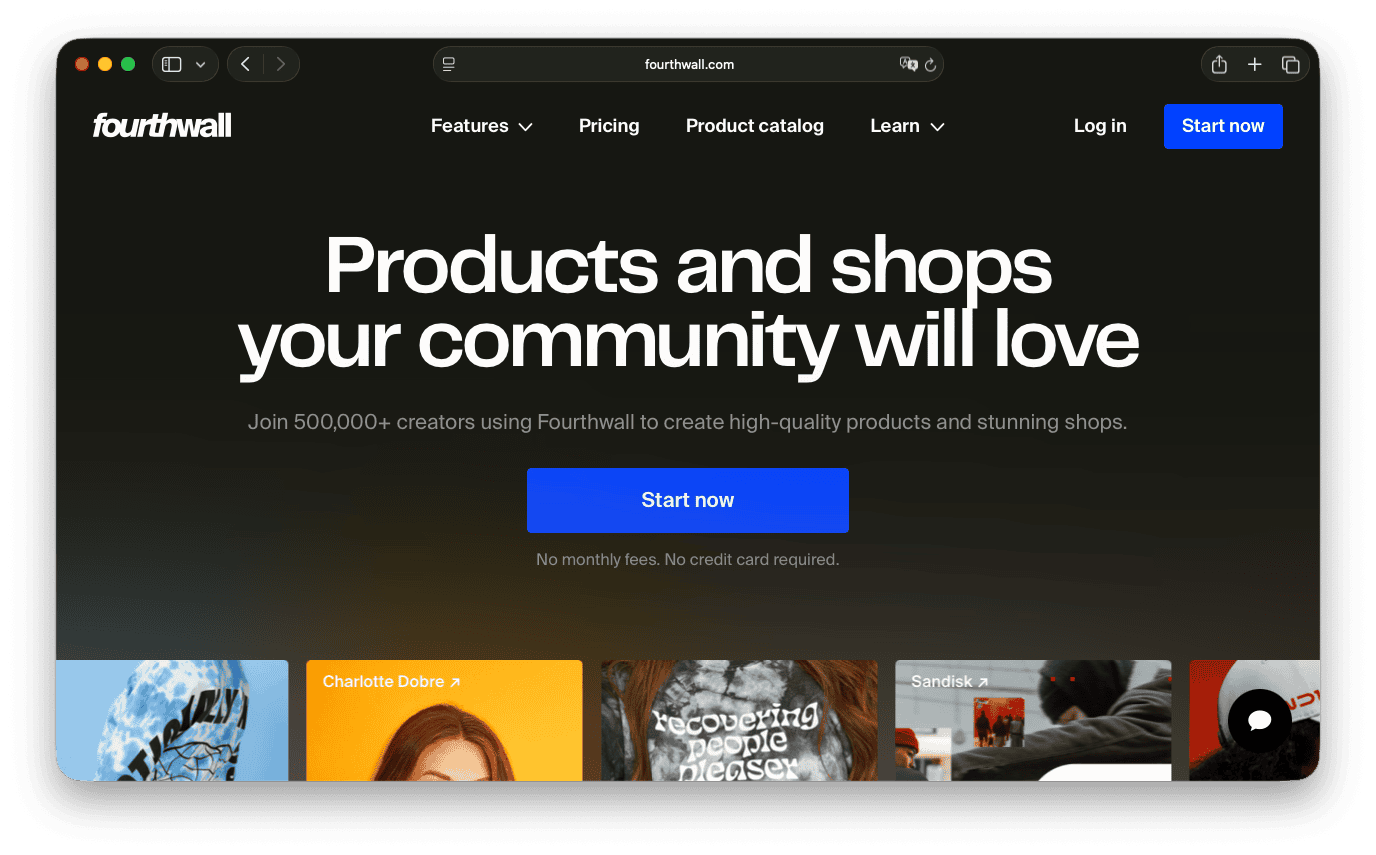
Fourthwall is built for creators who want to run their own branded store rather than list products inside someone else's marketplace. You sell merchandise under your own brand, and Fourthwall's fulfillment partners handle production, packaging, and shipping.
The product catalog covers hundreds of customizable items across apparel, accessories, home goods, and drinkware, printed using methods like direct-to-garment (DTG), embroidery, screen printing, direct-to-film (DTF), and sublimation depending on the product.
One reviewer, who had used several print-on-demand platforms before settling on Fourthwall, put it this way:
Pros
- Branded storefront you fully control, instead of a listing inside someone else's marketplace
- Merchant of Record handles sales tax and VAT for you on applicable transactions
- Multiple revenue streams in one place, including merchandise, digital products, memberships, and tips
- Native platform integrations, including TikTok Shop, YouTube Merch Shelf, and Twitch
- Multiple printing methods, including DTG, embroidery, screen printing, DTF, and sublimation
- Global fulfillment across major regions, including the US, UK, EU, and Australia
Cons
- Engraving, embossing, and other niche printing methods aren't available
- Designed for on-demand orders, so it isn't the right fit for bulk or wholesale production
- No built-in marketplace, so sales depend on the audience you bring rather than shoppers browsing the platform
A Summary of Fourthwall's Trustpilot Reviews
Fourthwall holds a 4.2 out of 5 rating on Trustpilot from 370+ reviews. Reviewers frequently mention a clean, easy-to-set-up storefront and being able to launch products quickly without prior technical experience. Support responsiveness and clear, transparent breakdowns of fees and payouts also come up often as reasons creators stay on the platform.
Pricing
Fourthwall is free to use, with no charges until you make a sale. There's no upfront or monthly fee for the storefront, physical or digital products, or memberships.
On the Free plan, Fourthwall earns its margin on catalog products rather than charging a platform fee.
Other costs are 2.9% + $0.30 card processing, 5% on memberships, and 5% on digital products.
Pro ($19/month or $180/year) drops the digital-product fee to 0% and adds higher limits, priority support, and a free domain.
Fourthwall vs Spreadshirt: Pricing Breakdown
Both platforms give you a free branded store, and both handle payments and sales tax for you. The difference is how much of each sale you keep. Spreadshirt's base price for a tee is higher, so your margin at the same retail price is smaller.
Here's what you earn selling a Bella+Canvas tee at $25 through each platform's store, at 25 and 100 orders a month:
At the same $25 price, you keep about $7 more per shirt on Fourthwall, even after card processing. That adds up to roughly $180 more a month at 25 orders and about $547 more at 100.
Spreadshirt's selling point is their reach, not the margin. ts marketplace can put your designs in front of shoppers who've never heard of you, which Fourthwall doesn't offer. If you already have an audience sending people to your store, Fourthwall lets you keep more of each sale, and you can sell memberships and digital products from the same store.
2. Printful
Average customer rating: Trustpilot: 4.2 (7.8K+ reviews)
Printful is the best Spreadshirt alternative for sellers who want premium print quality and deep branding control.

Printful is a print-on-demand fulfillment platform for sellers who already have a storefront on Shopify, WooCommerce, Etsy, or elsewhere. Instead of listing products in a shared marketplace, you connect your store and Printful handles production and shipping as orders come in.
Printful runs its own production facilities rather than routing orders to third-party providers, which gives it tighter control over print quality. Printful also includes a Design Maker and Mockup Generator, so you can preview products realistically before publishing them.
Pros
- In-house production at Printful's own facilities, with a quality check on every order
- Deep branding options, including custom packaging and labeling on eligible products
- Advanced mockup and design tools for previewing products before launch
- Broad integrations with major ecommerce platforms and marketplaces
Cons
- No built-in storefront or marketplace, so you need your own store to sell through
- Growth plan required for lower per-item costs and branding perks, which adds a monthly cost as you scale
- No digital products or memberships, since Printful is fulfillment-only
A Summary of Printful's Trustpilot Reviews
Printful holds a 4.2 out of 5 rating on Trustpilot from 7,800+ reviews. Reviewers frequently cite consistent print quality and responsive support, though a portion of reviews mention delays during high-volume periods.
Pricing
Printful is free to use, and you pay the product cost plus shipping only when an order comes in. The paid Growth plan runs $24.99/month and unlocks lower per-item pricing and additional branding perks. It becomes free automatically once your store reaches $12,000 in sales per year. An Enterprise tier with custom pricing is available for high-volume sellers.
3. Redbubble
Average customer rating: Trustpilot: 4.4 (54K+ reviews)
Redbubble is the best alternative to Spreadshirt for artists who want passive exposure on a large existing marketplace.
Redbubble is a marketplace where artists upload designs to a shared catalog instead of running their own store. Shoppers browse Redbubble directly, discover new designs through search and recommendations, and the platform handles printing, shipping, and customer support on every order.

Creators choose Redbubble because they can make sales without an existing audience, since Redbubble's traffic does part of the discovery work.
But it comes with caveats. There are many sellers on a shared platform, so standing out is challenging. Plus, you don’t have a dedicated storefront of your own.
Pros
- Large built-in audience, so new designs can be discovered without outside marketing
- Zero setup cost or technical requirement to start listing designs
- Fully managed fulfillment and support, including customer service on every order
- Global marketplace reach across multiple countries
Cons
- Standard accounts can pay up to 50% of monthly earnings in account fees until sales move them to a higher tier
- No dedicated storefront or brand identity, since listings live inside Redbubble's shared marketplace
- Limited control over customer relationships, because Redbubble owns the checkout experience
A Summary of Redbubble's Trustpilot Reviews
Redbubble holds a 4.4 out of 5 rating on Trustpilot from 54,000+ reviews. Most of these reviews come from shoppers rather than sellers, so they reflect the buying experience more than seller sentiment. Reviewers commonly mention print quality and shipping speed as strengths.
Pricing
Redbubble is free to join, and account fees depend on your account tier. Standard accounts pay an account fee of up to 50% of monthly earnings, which drops to 20% on Premium accounts and 0% on Pro accounts as your sales volume grows. A separate excess markup fee of 50% applies to earnings from markup set above 20% on any tier. Fees only apply in a pay period when you actually make a sale, and total account fees are capped at $150 per month.
4. Printify
Average customer rating: Trustpilot: 4.5 (7.6K+ reviews)
Printify is the best alternative to Spreadshirt for sellers who want to prioritize product selection and cost comparison across print providers.

Instead of running its own factories, Printify connects sellers to a network of independent print providers. You design a product once, and Printify routes orders to whichever provider in its network best matches your location, product, and price point, giving you a way to compare costs and turnaround across multiple suppliers.
Quality and shipping times depend on which independent provider fulfills your order, so results can vary from one order to the next. Upgrading to Premium adds Sellers Club PRO, giving you one-on-one mentorship and support as you scale.
Pros
- Large provider network offering more product and cost options to compare
- Cost comparison tools to help you find competitive pricing across providers
- No platform, listing, or hidden fees on the free plan
- Sellers Club PRO on the Premium plan, with one-on-one mentorship and support
Cons
- Quality and shipping times vary by provider, since orders are fulfilled by independent third parties rather than one consistent facility
- No built-in storefront or marketplace, so you need your own store to sell through
- The biggest product discounts (up to 33%) sit behind the $39/month Premium plan, so lower costs come with a monthly fee
A Summary of Printify's Trustpilot Reviews
Printify holds a 4.5 out of 5 rating on Trustpilot from 7,600+ reviews. Reviewers frequently mention ease of use and product variety, with occasional notes about fulfillment differences between providers.
Pricing
Printify is free to use, with no listing or platform fees. Printify earns its margin on the fulfillment price you pay when an order comes in, and you set your own retail price. The Premium plan is $39/month, or about $24.99/month if billed annually at $299/year, and includes Sellers Club PRO access. A custom Enterprise tier is available for high-volume sellers.
5. Gelato
Average customer rating: Trustpilot: 4.2 (3.3K+ reviews)
Gelato is the best alternative to Spreadshirt for sellers who already have a store and need a global fulfillment backend.

Gelato is a global fulfillment platform that connects your existing store to more than 250 production partners across 32 countries. Each order goes to the facility closest to the customer, which cuts shipping distance and speeds up delivery in many regions.
Gelato doesn't come with a storefront, so it works by connecting to a store you already run elsewhere. For creators with a global customer base, Gelato's main advantage is faster international delivery through local production.
Pros
- Local production network spanning 32 countries
- Faster shipping in many international markets thanks to localized production
- Integrates with Shopify, Etsy, WooCommerce, Wix, Squarespace, and more
- Pricing tools to help estimate margins before you set retail prices
Cons
- No built-in storefront, so you connect your own store to sell through
- Smaller product catalog than some larger marketplace-style competitors
- Gelato+ is required for the best perks, including up to 33% off products, AI mockup tools, Personalization Studio, and branded packaging
A Summary of Gelato's Trustpilot Reviews
Gelato holds a 4.2 out of 5 rating on Trustpilot from 3,300+ reviews. Reviewers commonly highlight fast local delivery and consistent print quality across regions. Less positive reviews mention slow support response times, shipping delays, damaged deliveries from thin packaging, and frustration with automated support chats.
Pricing
Gelato is free to use, and you pay the product base cost plus shipping per order. The optional Gelato+ plan is $29.99/month billed monthly, or $19.99/month billed annually ($239.88/year), unlocking product discounts and additional tools.
6. Tapstitch
Average customer rating: Trustpilot: 4.3 (530+ reviews)
Tapstitch is the best alternative to Spreadshirt for fashion founders and brands building a premium streetwear or apparel label.

Tapstitch is a print-on-demand platform designed for fashion brands, not general merch sellers. Tapstitch keeps production in-house at hubs in the US and China, positioning that control as a way to deliver more consistent garments than third-party fulfillment.
The catalog focuses on premium apparel, with fitted cuts, distinct fabrics, and streetwear-style pieces instead of standard blanks.
Custom neck labels, hang tags, packaging, and branded order tracking pages help Tapstitch sellers present their merch as a clothing label.
Pros
- In-house production across US and China facilities, aimed at more consistent garment quality
- Premium apparel catalog, with fitted cuts and fabrics geared toward fashion and streetwear brands
- Deep branding options, including custom neck labels, hang tags, packaging, and order tracking pages
- No order minimums, so you can launch a single piece or scale to larger runs
Cons
- No built-in storefront or marketplace, so you need your own store to sell through
- Narrower catalog than general POD platforms, since it's focused on apparel rather than home goods, drinkware, or accessories
- Less brand recognition than larger, longer-established POD platforms
A Summary of Tapstitch's Trustpilot Reviews
Tapstitch holds a 4.3 out of 5 rating on Trustpilot from 530+ reviews. Reviewers frequently mention garment quality and being able to start a clothing brand without holding inventory. Less positive reviews mention inaccurate/small sizing, shipping delays with poor support communication, and unexpected shipping fees.
Pricing
Tapstitch is free to use, with no monthly fee and no minimum order quantity. You pay the per-item production cost when an order comes in and set your own retail price on top.
7. TeePublic
Average customer rating: Trustpilot: 4.4 (652K+ reviews)
TeePublic is the best alternative to Spreadshirt for artists seeking marketplace distribution with existing buyer traffic.

TeePublic is a marketplace built for artists who want distribution without building their own audience first. The biggest difference at TeePublic is its payout model, where each sale earns a fixed dollar amount rather than a cut of the retail price.
<blockquote class="blog-details_blockquote"><strong>For context:</strong> TeePublic runs on the same marketplace model as Redbubble, its sister site under Articore, so the built-in audience comes at the cost of branding and pricing control.</blockquote>
Pros
- Large existing marketplace audience, useful for artists without an existing following
- Fixed per-item earnings, which makes payouts predictable regardless of your listed price
- Zero setup cost, with printing, shipping, and support fully handled by TeePublic
- Frequent sales and promotions that can drive volume, even though they lower per-sale earnings
Cons
- Fixed earnings don't scale with retail price, so you can't increase margin by raising your price
- No dedicated storefront or brand identity, since designs live inside TeePublic's shared marketplace
- Limited control over discounting, because TeePublic runs its own promotions that affect your payout
A Summary of TeePublic's Trustpilot Reviews
TeePublic holds a 4.4 out of 5 rating on Trustpilot from 652,000+ reviews. The large majority of these reviews come from shoppers rather than sellers, so they speak more to the buying experience than to artist sentiment.
Reviewers commonly mention print quality and customer service. Less positive reviews mention occasional sizing inconsistencies, minor print defects, and longer-than-expected delivery times.
Pricing
TeePublic is free to join, with no listing fees. Instead of a percentage royalty, artists earn a fixed dollar amount per item sold that varies by earnings tier. For example, a standard T-shirt pays $4 regular / $2 on sale at the Artisan tier, or $3 regular / $1 on sale at the Apprentice tier.
8. Zazzle
Average customer rating: Trustpilot: 4.4 (29K+ reviews)
Zazzle is the best alternative to Spreadshirt for designers selling highly customizable or personalized products.

Zazzle is a marketplace built around deep product personalization, letting shoppers customize colors, text, and images on many listings in real time.
Designers upload editable templates instead of fixed designs, and Zazzle's existing customer base brings the buyers.
Zazzle lets designers set their own royalty rate within a defined range, which offers more margin control than fixed-payout marketplaces. You're still selling inside Zazzle's shared marketplace, though, not your own store.
Pros
- Large built-in customer base for design discovery without outside marketing
- Adjustable royalty rate (up to 50% on physical products, up to 99% on digital downloads) giving more margin control than fixed-payout marketplaces
- Deep personalization tools that let shoppers customize products in real time
- Fully managed fulfillment, with Zazzle handling production and shipping
Cons
- Royalty rates above 10% carry a 5% Excess Royalty Fee, and sales driven by Zazzle's own marketing or an Ambassador referral face a separate 35–50% Marketing Royalty Fee
- No dedicated storefront or brand identity, since products live inside Zazzle's shared marketplace
- Higher royalty rates raise product prices, which Zazzle says can lower conversion and visibility
A Summary of Zazzle's Trustpilot Reviews
Zazzle holds a 4.4 out of 5 rating on Trustpilot from 29,000+ reviews. As with other large marketplaces, most of these reviews reflect the shopper experience rather than designer sentiment.
Reviewers frequently mention product quality and shipping speed. Less positive reviews mention occasional print-quality issues like blurry text or misalignment, along with shipping delays beyond the promised timeline.
Pricing
Zazzle is free to join. Designers can set a royalty rate of 5%–50% on physical products and 5%–99% on digital downloads (capped at 5% on the Zazzle Heart line). Royalty rates above 10% carry an additional 5% Excess Royalty Fee. Sales driven by Zazzle's own marketing or another Ambassador's referral link are also subject to a department-based Marketing Royalty Fee of 35–50% of the creator's gross royalty.
How to choose the right Spreadshirt alternative
Most of these platforms handle printing and shipping, so the real differences come down to whether you have an audience, whether you already run a store, and how much you keep per sale. Use the table below to find your fit.
You also don't have to choose just one. Many creators keep a marketplace listing for discovery while running their own store for the audience they've already built, since you own your designs and can use them on more than one platform (just check each marketplace's terms on duplicate listings first).
If you already have an audience and want a storefront that's fully yours, with merch, memberships, and digital products under one brand, get started with Fourthwall for free.
FAQ
Fourthwall and Spreadshirt serve different needs. Spreadshirt's marketplace puts your designs in front of shoppers already browsing the site, which suits sellers who want passive discovery. Fourthwall is built for creators who already have an audience and want a fully branded store with merch, memberships, and digital products together, plus direct ownership of the customer relationship, which Spreadshirt's marketplace model doesn't offer.
Fourthwall is the best Spreadshirt alternative for creators who want a branded storefront instead of a marketplace listing. It combines merch, memberships, and digital products in one place, with no monthly fee required to get started. If you already run your own store and just need fulfillment, Printful or Gelato are strong picks. For creators who want marketplace exposure without building an audience first, Redbubble, TeePublic, or Zazzle are better fits.
Fourthwall, Printful, Printify, Tapstitch, and Gelato are the strongest alternatives for custom merchandise specifically. Each lets you create and sell custom-printed products, whether through your own branded storefront (Fourthwall) or connected to a store you already run (Printful, Printify, Gelato, Tapstitch). Redbubble, TeePublic, and Zazzle also support custom merchandise, but through a shared marketplace listing rather than an independent store.
Redbubble, TeePublic, and Zazzle are the closest matches to Spreadshirt's marketplace model, since all three let you upload designs to a shared catalog and rely on the platform's own traffic for discovery. Printful, Printify, Gelato, and Tapstitch work differently. They're fulfillment platforms you connect to your own store rather than marketplaces. Fourthwall differs from all of them by combining a branded storefront with merch, memberships, and digital products in one place.
Fourthwall is a strong upgrade from Spreadshirt for creators who want more control over their store and customer relationships, because it replaces a marketplace listing with a fully branded storefront that also supports memberships and digital products. If your priority is fulfillment quality behind a store you already run, Printful or Gelato are also worth comparing directly against Spreadshirt's production model.
Creators typically leave Spreadshirt because the marketplace listing model limits their brand control over their storefront and the customer experience. Margins can also feel thin, since Spreadshirt sets the base production cost and sellers compete on price within the same catalog. On top of that, the built-in tools for capturing customer data and running marketing campaigns are more limited than those in an independent store.
Richard is Head of Organic Growth at Fourthwall, with 14+ years of experience in the creator economy and ecommerce. He’s built businesses across the spectrum—from print-on-demand stores to custom cut-and-sew clothing lines, as well as selling digital products. He helps creators navigate merch strategy and build sustainable businesses.


You might also like

9 Best Kajabi Alternatives for Course Creators in 2026

What to Sell Online: How to Find a Product People Want

7 Best Sellfy Alternatives for Creators and Brands in 2026

27 Best Digital Products to Sell as a Creator
.webp)
Top 8 Wix Alternatives for Creators Building an Online Store in 2026

How to Create and Sell Print on Demand Journals and Notebooks

9 Gumroad Alternatives for Digital Creators in 2026

10 Best Stan Store Alternatives for Creators in 2026

9 Best Patreon Alternatives for Creators in 2026

Keep up with the latest from Fourthwall
New features, product updates, trend breakdowns, and creator stories — straight to your inbox.