
10 Best Stan Store Alternatives for Creators in 2026
Compare fees, features, and fit across 10 Stan Store alternatives to find the platform that matches how you sell.


The best Stan Store alternatives in 2026 are Fourthwall, Sellfy, Linktree, Podia, Gumroad, Beacons, Kajabi, Shopify, Ko-fi, and Patreon. Fourthwall suits creators who want merch, memberships, and digital products running from one fully branded storefront, starting at $0/month. Creators typically switch from Stan Store because it has no free plan, its physical products rely on workarounds rather than built-in fulfillment, and a link-in-bio page limits how much a store can be branded.
Stan Store is known for turning a link-in-bio page into a simple storefront, letting creators sell courses, coaching, and digital downloads without a separate website.
Creators typically start moving on once they hit its limits. Stan Store has no free plan, so you pay $29 a month before you make a sale. Its native product types stay mostly digital, so merch and physical products depend on workarounds rather than built-in fulfillment. And a link-in-bio page can only stretch so far once a creator wants a fully branded storefront with its own design and domain.
In this guide, we'll explore some of the best Stan Store alternatives to help you find a platform that fits how you actually want to sell.
Stan Store Alternatives at a Glance
1. Fourthwall
Average customer rating: Trustpilot: 4.3 (350+ reviews)
Fourthwall is the best alternative to Stan Store for creators, brands, and businesses that want merch, memberships, and digital products running from one branded storefront.
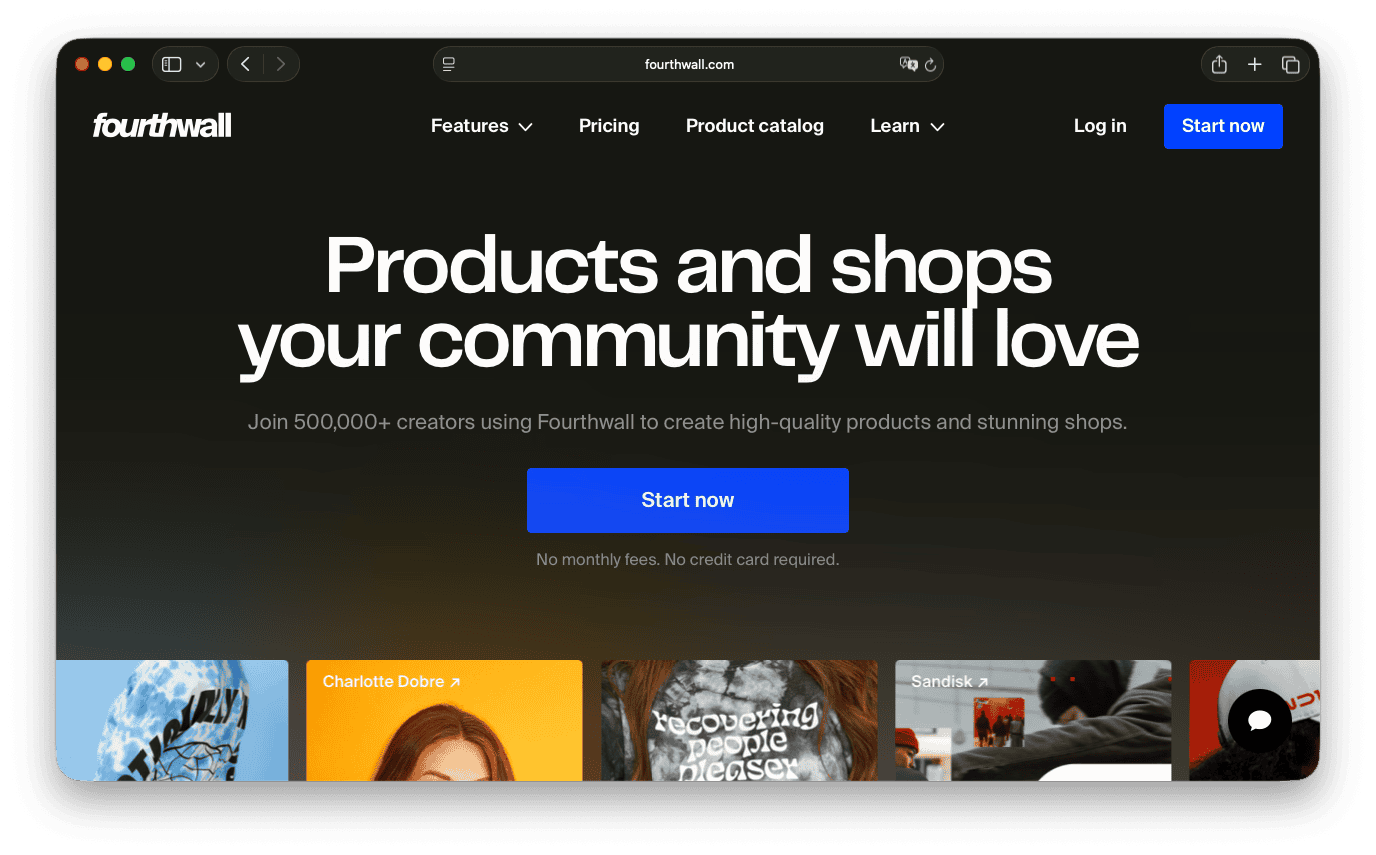
It's an all-in-one commerce platform that combines a fully branded storefront with physical products, digital products, and memberships in one place. Instead of a link-in-bio page pointing to a checkout, you get a real website you design yourself, with your own layout, colors, and domain.
Creators can sell hundreds of customizable print-on-demand products without holding inventory, alongside digital downloads like ebooks, presets, and courses.
They can also run tiered memberships with perks like Discord role sync and members-only content.
One streamer described the switch this way:
Fourthwall Pros
- Fully branded storefront with your own layout, colors, and custom domain, not a link list
- Merchant of Record handles applicable sales tax and VAT on transactions processed through the platform
- Print-on-demand merch alongside digital products and memberships in one store
- Native platform integrations, including TikTok Shop, YouTube Merch Shelf, Twitch Gifting, and many more
- Fourthwall handles support for Fourthwall-produced catalog orders, including qualifying replacements
Fourthwall Cons
- No native course builder, so structured lesson sequences aren't as deep as a dedicated course platform
- Digital products carry a 5% fee on Free (0% on Pro), where some competitors go straight to a flat monthly rate
- Built for on-demand selling rather than bulk manufacturing, so very high-volume physical orders aren't its strength
A Summary of Fourthwall's Trustpilot Reviews
Fourthwall's Trustpilot reviews consistently highlight responsive customer support, an easy setup process, and product quality that holds up once merch actually ships. Creators switching from other merch or link-in-bio tools frequently mention that the storefront felt more customizable and less like a generic template.
Fourthwall Pricing
Fourthwall's Free plan has no monthly fee, a 0% platform fee on physical products, a 5% fee on memberships and digital products, and a free .store domain. Card processing runs 2.9% + $0.30 per transaction, and donations carry 0% Fourthwall fee.
Pro costs $19/month, or $15/month billed annually, and drops the digital-product fee to 0% while adding a custom domain connection, a monthly sample credit, unlimited team members, and priority support.
Fourthwall vs Stan Store: Pricing Breakdown
Stan Store charges a flat monthly fee and takes no cut of your sales. Fourthwall's Free plan works the other way around, with no monthly fee but a 5% fee on digital sales. Fourthwall Pro combines both approaches: $19 a month and 0% on digital products.
Here's what selling a $25 digital product costs on each, at 25 and 100 sales a month:
Fourthwall Pro is the cheapest option at both volumes, costing $10 less a month than Stan's Creator plan for the same sales. Neither charges a cut of your digital sales, so the gap is simply the difference between the two plan fees.
Fourthwall's Free plan is cheaper than Stan while you're under about 23 sales a month, since its 5% fee costs less than Stan's $29. Past that point, Pro is the better Fourthwall plan, and it stays ahead of Stan at every volume.
The bigger difference is what each fee covers. Stan leaves sales tax registration and filing to you and doesn't offer built-in merch. Fourthwall handles tax as Merchant of Record and lets you sell print-on-demand merch alongside your digital products, on either plan.
2. Sellfy
Average customer rating: Trustpilot: 3.7 (70+ reviews)
Sellfy is the best alternative to Stan Store for digital creators and early-stage businesses that want digital products, subscriptions, and print-on-demand merch working together in one place.

Sellfy is an all-in-one storefront built for creators who want to sell digital products, subscriptions, and physical merch without stitching together separate tools. Setup is fast, and the dashboard stays simple even as you add product types.
Sellfy leans into selling tools rather than a simple link page: built-in email marketing, upselling, and abandoned cart recovery come standard, and its print-on-demand system lets you add physical products without touching inventory.
Sellfy Pros
- No transaction fees on any plan, so what you see on the price tag is what you pay
- Sells digital products, subscriptions, and print-on-demand merch from one storefront
- Built-in email marketing and abandoned cart recovery included on every paid plan
- Unlimited products, with no cap on how many items you can list
Sellfy Cons
- No free plan, so you're paying a subscription before you make your first sale
- Each plan caps annual sales volume, with a 2% overage fee if you exceed it before upgrading
- No native membership tiers or community features beyond simple recurring subscriptions
A Summary of Sellfy's Trustpilot Reviews
Sellfy's Trustpilot reviews tend to praise straightforward setup and the ability to sell digital and physical products from one dashboard, with some creators noting they'd like more advanced marketing automation as their store scales.
Sellfy Pricing
Sellfy's three plans, priced monthly or with a discount for annual billing:
- Starter: $29/mo ($22/mo annually), up to $10,000 in annual sales
- Business: $79/mo ($59/mo annually), up to $50,000 in annual sales
- Premium: $159/mo ($119/mo annually), up to $200,000 in annual sales
All three carry 0% transaction fees from Sellfy. PayPal or Stripe processing still applies on top, typically 2.9% + $0.30 in the US. New users can test any plan with a 14-day free trial.
3. Linktree
Average customer rating: Trustpilot: 4.0 (7.1K+ reviews)
Linktree is the best alternative to Stan Store for creators and social media users whose main need is a link hub with a bit of product selling built in.

Linktree is the platform most creators already know as the original link-in-bio tool. It centralizes every link, from social profiles to affiliate offers, into one customizable page designed for platforms that only allow a single bio link.
As a Stan Store alternative, Linktree works best for creators who are mainly directing traffic rather than building a full storefront. It has added Linktree Shops for selling digital products and courses, but it doesn't offer a course builder, memberships, or community tools the way some all-in-one platforms do.
Linktree Pros
- Widely recognized format that most followers already understand how to use
- Quick setup, with a functional link-in-bio page live in minutes
- Sell digital products and courses directly through Linktree Shops
- Email and automation integrations, including Mailchimp, Klaviyo, and Kit
Linktree Cons
- No native memberships or community tools, so recurring fan engagement depends on other platforms
- Seller fees on digital products range from 9-12% unless you're on the top Premium plan
- Limited storefront design, since Linktree is built around a link list rather than a full branded site
A Summary of Linktree's Trustpilot Reviews
Linktree's reviewers report are happy with: fast, polite support and an intuitive platform for managing their online presence. A minority report the opposite on support specifically, citing slow or unhelpful responses to login and verification issues, along with persistent account-access and authorization problems that went unresolved for extended periods.
Linktree Pricing
Linktree's Free plan covers unlimited links and lets you sell digital products at a 12% seller fee. Starter and Pro plans drop that fee to 9% and add personalization, analytics, and mailing list integrations. Premium removes Linktree's seller fee entirely on digital products and adds the Linktree affiliate shop.
4. Podia
Average customer rating: Trustpilot: 4.0 (140+ reviews)
Podia is the best alternative to Stan Store for solo creators and small businesses selling courses, coaching, and digital products alongside a community space.

Podia bundles a website, courses, digital downloads, and a community space into one platform built around creators selling knowledge products. It leans further into structured course delivery than Stan Store does, with dedicated tools for lessons, community spaces, and email marketing.
But Podia’s downside is the cost. Its plans run higher than Stan Store's, and the entry-level plan still carries a transaction fee until you upgrade.
Podia Pros
- Structured course builder with community spaces built in, not bolted on
- Unlimited members and sales on every plan
- Built-in email marketing, including automations, newsletters, and segmentation
- Free migration service to move products and customers over from another platform
Podia Cons
- Mover plan carries a 5% transaction fee, which only drops to 0% once you upgrade to Shaker
- Higher starting price than Stan Store, especially once you factor in the transaction fee at the entry tier
- No native print-on-demand or physical merch support
A Summary of Podia's Trustpilot Reviews
Podia's reviewers report a positive experience with digital workspace: a user-friendly, feature-rich platform and prompt, warm customer service from human agents. A minority report occasional technical hurdles, like custom domain setups, sales pages, or unexpectedly locked accounts, along with slow or unhelpful chatbot interactions during urgent moments.
Podia Pricing
Podia's three plans are billed monthly or at a discounted annual rate:
- Mover: $49/mo ($42/mo billed annually), 5% transaction fee
- Shaker: $99/mo ($84/mo billed annually), 0% transaction fee
- Earthquaker: $179/mo ($150/mo billed annually), 0% transaction fee
Stripe or PayPal processing fees apply separately, on top of the plan price and any transaction fee.
5. Gumroad
Average customer rating: Trustpilot: 1.4 (400+ reviews)
Gumroad is the best alternative to Stan Store for solo creators and ecommerce beginners who want the simplest setup.

Gumroad strips selling down to the basics. You upload a digital product, set a price, and share the link. There's no monthly subscription, no website to design, and no dashboard to learn beyond the product editor itself.
Gumroad now acts as merchant of record for sales made through the platform, so it also handles sales tax collection and remittance, which narrows one of the gaps that used to separate it from more full-featured platforms.
Gumroad Pros
- No monthly fee, so there's nothing to pay until you make a sale
- Fast setup, often just a few minutes from signup to a live product
- Merchant of Record, handling sales tax collection and remittance on transactions
- Discover marketplace gives products a small chance at organic discovery beyond your own audience
Gumroad Cons
- 10% + $0.50 fee on direct sales is higher than several flat-rate competitors, though it drops to 5% + $0.50 once you clear $20,000 in a calendar month
- Discovery sales through the Gumroad marketplace carry a 30% fee
- No physical product fulfillment or storefront design tools, since Gumroad is built around single product listings rather than a branded site
A Summary of Gumroad's Trustpilot Reviews
Gumroad's reviews frequently mention how quick it is to get a first product live, with some creators noting the per-sale fee adds up faster than a flat subscription once volume grows.
Gumroad Pricing
Gumroad is free to use with no monthly fee. Direct sales through your own links or profile carry a 10% + $0.50 fee, which drops to 5% + $0.50 once your paid sales in a calendar month reach $20,000. Sales made through Gumroad's Discover marketplace carry a flat 30% fee that includes processing. Credit card processing is included in Gumroad's fee rather than charged separately.
6. Beacons
Average customer rating: Trustpilot: 1.8 (40+ reviews)
Beacons is the best alternative to Stan Store for creators, influencers, and digital entrepreneurs who want their link-in-bio page backed by AI tools and a built-in store.

Beacons pairs a link-in-bio page with a store, email tools, and AI-assisted features like media kit generation and content suggestions. It's built for creators who want more automations, without jumping to a full custom storefront.
Product importing from other platforms and a broader free tier make it an easier on-ramp than some competitors, though the free plan's transaction fee is worth weighing against Stan Store's flat monthly cost.
Beacons Pros
- AI-assisted tools for media kits, content, and brand outreach
- Product importing from other platforms speeds up moving your catalog over
- Multiple product types in one store, including digital products, memberships, and bookings
- 0% transaction fees once you reach the Creator Plus plan
Beacons Cons
- 9% transaction fee on Free and Creator plans, only dropping to 0% on Creator Plus at $30/month (or $25/month billed annually)
- Logo and branding removal requires a paid plan
- Physical product support depends more on integrations than a native print-on-demand catalog
A Summary of Beacons' Trustpilot Reviews
Beacons' reviews often highlight the AI tools and all-in-one convenience of combining a link page with selling features, with mixed feedback on the free plan's transaction fee once creators start making regular sales.
Beacons Pricing
- Free: 9% transaction fee on sales
- Creator: $8.33/mo billed annually ($10/mo month-to-month); keeps the 9% fee, adds a custom domain and more email sends
- Creator Plus: $25/mo billed annually ($30/mo month-to-month); drops transaction fees to 0% and adds memberships and buy-now-pay-later
- Creator Max: $75/mo billed annually ($90/mo month-to-month); adds white-glove support for larger operations
7. Kajabi
Average customer rating: Trustpilot: 3.4 (2.3K+ reviews)
Kajabi is the best alternative to Stan Store for online course creators and coaches who need deeper funnels and marketing automation.

Kajabi is built for creators running a course-centered business rather than a simple digital storefront. It bundles course hosting, sales funnels, email automation, and a website into one platform, aimed at creators with an established offer who want to scale marketing around it.
The platform’s depth comes at a higher price point than Stan Store, so Kajabi tends to make more sense once you have validated demand and need the automation to match.
Kajabi Pros
- 0% platform transaction fee on course and product sales, with only standard payment processing applying
- Advanced sales funnels built specifically for launching and scaling course offers
- Podcast hosting integrated alongside course and community tools
- Unlimited landing pages and marketing emails on every plan
Kajabi Cons
- Highest starting price on this list, at $143/month billed annually
- Contact and product limits on lower tiers can require an upgrade sooner than expected as a list grows
- No native physical product or merch support
A Summary of Kajabi's Trustpilot Reviews
Kajabi's reviews tend to praise the depth of its marketing and automation tools for course creators, while some reviewers note the price is a real commitment compared to lighter platforms.
Kajabi Pricing
Kajabi has three plans, all with a 0% platform transaction fee:
- Basic: $143/mo billed annually ($179/mo month-to-month); 5 products, 2,500 contacts
- Growth: $199/mo billed annually ($249/mo month-to-month); 50 products, 25,000 contacts, adds affiliate features
- Pro: $399/mo billed annually ($499/mo month-to-month); unlimited products, 100,000 contacts
Kajabi Payments processing starts around 2.9% + $0.30 and steps down on higher plans. Using a third-party processor adds a separate surcharge on top.
8. Shopify
Average customer rating: G2: 4.4 (5K+ reviews)
Shopify is the best alternative to Stan Store for independent creators and high-volume brands running a full retail operation.

Shopify is the general-purpose ecommerce platform creators move to once they're managing serious inventory, want a large app ecosystem, or need point-of-sale tools for in-person selling alongside their online store. It's a bigger operational step up from Stan Store than most other alternatives on this list.
Physical products and digital products both work on Shopify, but merch and memberships typically require apps rather than native tools, so the platform rewards creators who want maximum flexibility and are comfortable configuring it.
Shopify Pros
- Massive app ecosystem covering nearly any feature a store might need
- Point-of-sale tools for creators who also sell in person at events or pop-ups
- 0% Shopify platform fee, with card processing built into the plan price
- Multi-currency and localized global selling for creators selling internationally
Shopify Cons
- Highest starting price among storefront-first alternatives, at $29/month billed annually before any apps
- Native memberships and print-on-demand aren't built in, so both usually require paid apps
- More setup complexity than a purpose-built creator platform, since Shopify is built for general retail first
A Summary of Shopify's Reviews
Shopify's reviews often point to the strength of its app ecosystem and flexibility for scaling a store, with some smaller creators noting that assembling the right app stack for creator-specific features adds cost and setup time.
Shopify Pricing
Shopify has four plans, all with a 0% platform fee:
- Basic: $29/mo billed annually ($39/mo month-to-month); card rates from 2.9% + $0.30 online
- Grow: $79/mo billed annually ($105/mo month-to-month); lower card rates and added staff accounts
- Advanced: $299/mo billed annually ($399/mo month-to-month); for larger operations
- Plus: from $2,300/mo; for high-complexity businesses
The cost you feel comes from the subscription and card processing rates, not a platform take rate on sales.
9. Ko-fi
Average customer rating: Trustpilot: 4.6 (760+ reviews)
Ko-fi is the best alternative to Stan Store for writers, artists, and independent creators who want tips, memberships, and a shop without a subscription commitment.

Ko-fi centers on low-pressure support, letting creators collect tips, run memberships, take commissions, and sell through a simple shop, all without a subscription required to get started. Creators keep tips completely fee-free and only pay Ko-fi's service fee on the features they actually use.
It doesn't try to be a full storefront replacement the way Fourthwall or Shopify do. But for creators whose Stan Store usage was mostly about collecting support and selling a few digital items, Ko-fi covers the same ground at a lower cost.
Ko-fi Pros
- 0% fee on one-time tips, with no subscription required to collect them
- Memberships, Shop, and Commissions all included at a flat 5% fee if you skip Gold
- Gold plan removes the 5% fee entirely for $12/month
- No listing fees on Shop products
Ko-fi Cons
- 5% service fee on Shop, memberships, and commissions unless you pay for Gold
- No native print-on-demand fulfillment, so physical products depend on the creator handling logistics
- Storefront design is simple rather than fully branded
A Summary of Ko-fi's Trustpilot Reviews
Ko-fi's Trustpilot page shows a 4.6 out of 5 rating from more than 760 reviews. Most reviewers highlight an approachable interface and helpful support, while a smaller group cite account removals or unclear answers around specific moderation decisions.
Ko-fi Pricing
Ko-fi is free to join, with two ways to pay:
- Standard: $0/month; 0% fee on one-time tips; 5% service fee on Shop, Membership Tiers, and Commissions
- Gold: $12/month; 0% fee across all of it, including Shop, memberships, and commissions
Standard PayPal and Stripe processing fees of around 3% + $0.30 apply regardless of plan.
10. Patreon
Average customer rating: Trustpilot: 1.2 (900+ reviews)
Patreon is the best alternative to Stan Store for independent creators focused on building recurring membership revenue.

Patreon remains the most recognized membership platform for creators building recurring fan revenue. Its tiered membership system, built-in discovery, and mobile app give it reach that a link-in-bio page can't match on its own.
Newer creator pages now pay a standard 10% platform fee rather than the lower legacy rates some longtime creators still have, which is worth factoring in against Stan Store's flat $29/month if memberships are your main product.
Patreon Pros
- Established brand recognition that many fans already trust and use
- Tiered membership system with flexible pricing and perks per tier
- Built-in discovery that can surface your page to new potential members
- Native video hosting included for paying fans
Patreon Cons
- Standard 10% platform fee for new creator pages, higher than several competitors on this list
- 2.5% currency conversion fee on payments made in a different currency than your payout currency
- No native print-on-demand or storefront design tools, since Patreon is built around memberships specifically
A Summary of Patreon's Trustpilot Reviews
Patreon's reviewers report unhelpful support that leans on repetitive automated replies, along with billing errors, disputed charges, and difficulty canceling subscriptions. A smaller group still find value in the underlying concept, calling it useful for supporting creators and discovering digital content despite these management issues.
Patreon Pricing
Patreon has one standard fee structure for creator pages published after August 4, 2025:
- Platform fee: 10% on successfully processed membership and one-time purchase payments
- Payment processing: roughly 2.9% + $0.30 per transaction in the US
- Currency conversion: 2.5% fee when a member pays in a different currency than your payout currency
Patreon itself is free to join.
How to choose the right Stan Store alternative
Rather than weighing every feature against every other platform, start with the one thing that's holding you back.
Want an all-in-one store without stitching tools together? Fourthwall covers the branded storefront, merch, memberships, and digital products in one place, without the $29 monthly floor Stan Store charges before you make a sale.
Mainly selling digital downloads and want the lowest barrier to entry? Gumroad gets a product live in minutes with no subscription, though its per-sale fee adds up faster at volume. Sellfy is worth a look if you want digital products, subscriptions, and print-on-demand merch together without a free plan's transaction-fee ceiling.
Building a course business specifically? Podia and Kajabi both go deeper than Stan Store on structured lessons and funnels, with Kajabi aimed at creators who've already validated demand and want heavier automation, and Podia sitting at a more approachable price.
Mostly using Stan Store for link-in-bio traffic with light selling? Linktree and Beacons keep that format while adding more commerce tools than Stan Store's page-first approach.
Are tips, memberships, and community support the whole point? Ko-fi and Patreon both do that well, with Ko-fi charging less if you're willing to pay a small monthly fee to skip its service cut.
Managing real inventory and need a bigger app ecosystem than any creator-first platform offers? Shopify makes the most sense at that scale.
Match the platform to what you're actually selling first, then weigh the fee structure against your expected volume.
If you're still not sure where to start, Fourthwall's Free plan is the lowest-risk way to test an all-in-one setup before committing anywhere else.
FAQ
Fourthwall is the better fit for YouTubers and streamers whose main product is merch, because it connects directly to YouTube Merch Shelf and Twitch Gifting, letting products sit next to the content that drives demand. Fourthwall also includes native print-on-demand fulfillment and no required monthly fee, while Stan Store starts at $29 per month and does not offer built-in print-on-demand or YouTube Shopping integration.
Kajabi and Shopify are the Stan Store alternatives with the best fee profile for high-volume sellers, charging 0% platform fee so a growing seller pays only the fixed subscription and payment processing. Those costs shrink as a share of revenue as sales grow. Gumroad's per-sale fee drops from 10% + $0.50 to 5% + $0.50 once monthly paid sales reach $20,000. Fourthwall keeps its 0% fee on physical products at every volume, since the cost is built into each product's base price rather than charged as a percentage of the sale.
Podia and Kajabi are the Stan Store alternatives built specifically around structured courses and coaching, with lesson hosting, drip content, and student progress tracking. Podia bundles courses with a community and email tools starting at $42 per month billed annually, while Kajabi adds heavier funnel and automation features starting at $143 per month billed annually.
Linktree, Beacons, and Fourthwall all pair a link-in-bio landing page with a real product storefront, so creators can keep the social bio flow while selling from the same URL. Linktree charges 12% on Free and 9% on Starter and Pro, Beacons charges 9% on Free and Creator, and Fourthwall lets creators design a full branded site with 0% platform fee on physical products and no monthly cost.
Most Stan Store alternatives let creators recreate Stan Store products manually or import them through CSV, but Stan Store customer email lists usually need to be exported from Stan Store's dashboard and imported into the new platform's email tool separately. Fourthwall, Gumroad, and Sellfy all support bulk product setup, and creators typically rebuild the storefront on the new platform before pointing their link-in-bio away from Stan Store to avoid downtime.
Richard is Head of Organic Growth at Fourthwall, with 14+ years of experience in the creator economy and ecommerce. He’s built businesses across the spectrum—from print-on-demand stores to custom cut-and-sew clothing lines, as well as selling digital products. He helps creators navigate merch strategy and build sustainable businesses.


You might also like

7 Best Sellfy Alternatives for Creators and Brands in 2026

9 Gumroad Alternatives for Digital Creators in 2026
.webp)
Top 8 Wix Alternatives for Creators Building an Online Store in 2026

9 Best Patreon Alternatives for Creators in 2026

8 Best Printful Alternatives for Print-on-Demand in 2026

9 Best Kajabi Alternatives for Course Creators in 2026

8 Buy Me a Coffee Alternatives for Creators in 2026

12 Best UGC Platforms for Creators in 2026
.webp)
Finding the Best Membership Platform for Your Community
Keep up with the latest from Fourthwall
New features, product updates, trend breakdowns, and creator stories — straight to your inbox.