
9 Best Zazzle Alternatives for Print-on-Demand Sellers in 2026
How each option compares on payout per sale, built-in shopper traffic, and brand control.


Zazzle alternatives in 2026 include Fourthwall, Printful, Redbubble, Gelato, Printify, Society6, TeePublic, Etsy, and Sellfy. On a $25 t-shirt, a seller keeps about $12.22 on Fourthwall versus about $1.25 at Zazzle's standard 5% royalty, though Zazzle brings built-in marketplace traffic.
Zazzle is a print-on-demand marketplace where designers upload artwork, set a royalty, and let Zazzle handle production, shipping, and a large built-in shopper base. The platform is easy to begin with and offers deep personalization, suitable for invitations and stationery.
But Zazzle’s downsides start showing up as you grow. The standard royalty rate starts at 5%, your products live inside Zazzle's marketplace rather than a store with your own branding, and digital downloads are limited to specific template categories.
If you are researching Zazzle alternatives, the right pick depends on whether you want marketplace traffic or a brand you own. In this guide, we'll explore nine options, including marketplaces, fulfillment networks, and branded storefronts, so you can match the platform to your goal.
Zazzle Alternatives at a Glance
1. Fourthwall
Average customer rating: 4.3/5 on Trustpilot from 370+ reviews
Fourthwall is the best alternative to Zazzle for creators with an audience who want merch, digital products, and memberships in one branded store.
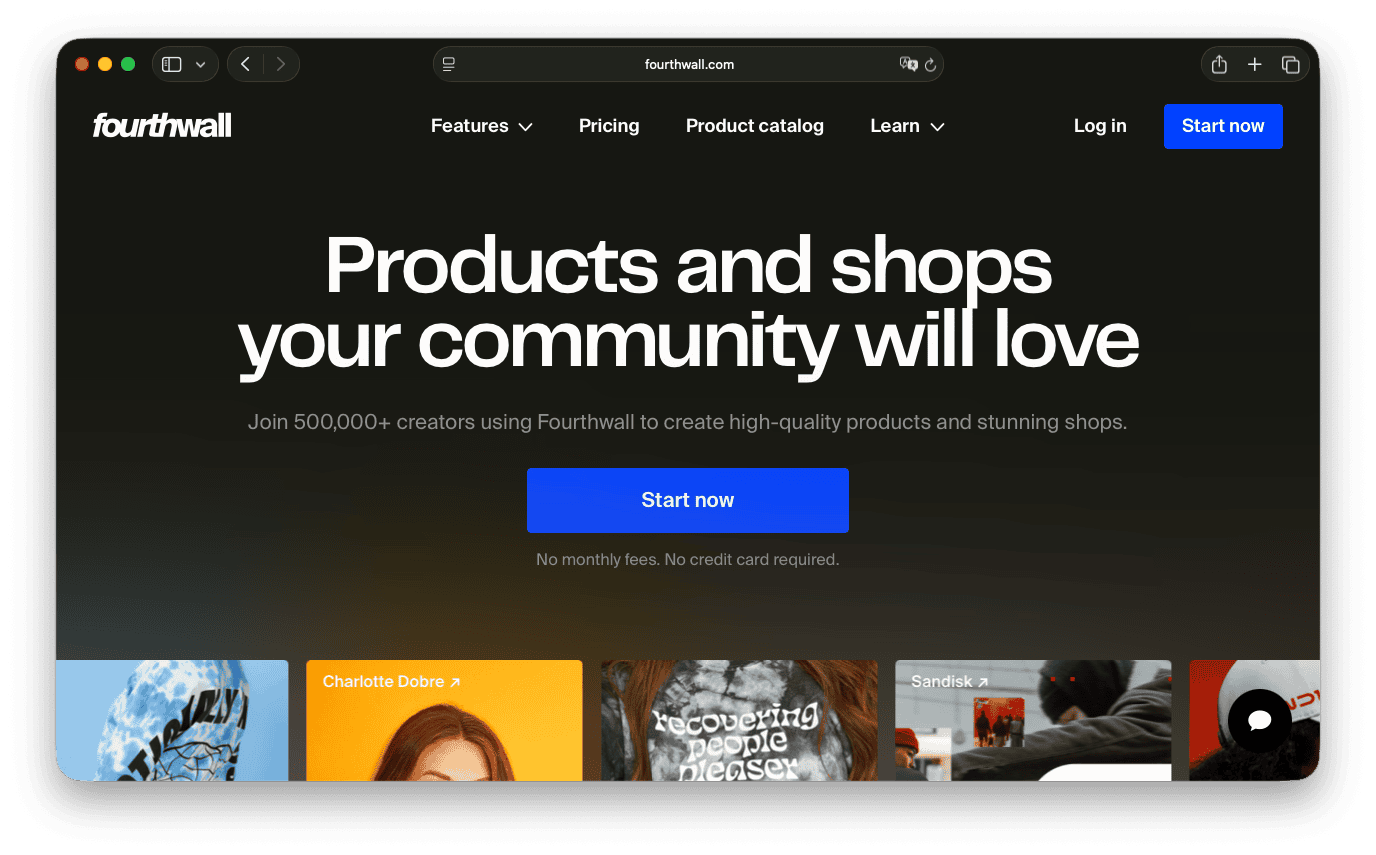
With Fourthwall, you get a fully branded shop where you set your own prices and margins, choose from hundreds of customizable print-on-demand products, and never buy inventory upfront.
Products are made after an order comes in. For Fourthwall-produced catalog orders, the platform handles production, shipping, and end-customer support.
Besides merch, you can add digital products like presets, ebooks, or art files, and offer memberships with tiers and perks, all under the same storefront and domain.
For creators who already have a following on YouTube, Twitch, or TikTok, this setup lets you send them directly to your store. But if you want strangers to be able to discover your designs through a search on a big marketplace, keep Zazzle or explore other marketplace options.
Pros of Fourthwall
- Fully branded storefront with your own domain, where you set prices and margins
- You don’t have to buy inventory, and there are no order minimums on catalog products
- Digital products and memberships sit in the same store as your merch
- Acts as Merchant of Record for applicable transactions, including sales tax and VAT handling
Cons of Fourthwall
- There is no built-in shopper marketplace, so you bring the audience through your channels
- You are responsible for customer support on any products you fulfill yourself
- Payment processing (2.9% + $0.30 on US cards) and platform fees on memberships (5%) and Free-plan digital products (5%) still apply
A Summary of Fourthwall's Trustpilot Reviews
Fourthwall holds 4.3 out of 5 on Trustpilot from 370+ reviews, and most reviewers describe a great experience. They single out how easy it is to set up a store, along with the clean interface, reliable analytics, and a support team they describe as quick, knowledgeable, and invested in helping creators grow. Some reviewers, though, mention slow replies when they needed urgent help with account issues.
Fourthwall Pricing
Fourthwall is free to start, and you earn the difference between your retail price and the product's base cost.
- Free plan: $0 per month, with no upfront costs and no contracts
- Catalog products: You set the retail price. The publicly listed base cost is deducted, and there is no extra percentage on your margin
- Products you source yourself: 0% platform fee
- Digital products: 5% fee on Free, 0% on Pro
- Memberships: 5% fee on both plans
- Donations: No platform fee beyond payment processing
- Payment processing: 2.9% + $0.30 on US card transactions. Rates for PayPal and other methods vary
- Pro plan: $19 per month, or $15 per month billed annually. Pro removes the digital-product fee and adds 100 GB of digital storage (up from 5 GB), unlimited team members (up from 2), $10 of shop credit each month for samples, a free .store domain, and priority 24/7 support
Fourthwall vs Zazzle: Pricing Breakdown
Fourthwall and Zazzle pay you in different ways. On Fourthwall, you set the retail price and keep everything above the product's base cost. On Zazzle, you earn a royalty: a percentage of the sale price that you choose, with Zazzle's fees coming out of that royalty.
Here's what you keep selling a t-shirt at $25 on each platform, at three common Zazzle royalty rates, at 25 and 100 orders a month:
At the same $25 price, you keep about $12 per shirt on Fourthwall. On Zazzle, even a 20% royalty leaves you under $5, and the 5% standard rate pays $1.25. At 100 orders a month, that's roughly $1,222 on Fourthwall compared with $125 to $475 on Zazzle, before any marketing fees.
What Zazzle offers instead is a built-in marketplace. Shoppers can find and personalize your designs without you sending them there, and Zazzle handles production, shipping, and customer service. It's a low-effort way to test designs. If you already have an audience to bring, Fourthwall lets you keep far more of each sale, and you own the customer relationship.
2. Printful
Average customer rating: 4.2/5 on Trustpilot from 7.8K+ reviews
Printful is the best alternative to Zazzle for sellers building their own brand with premium fulfillment and branding add-ons.

Printful is a print-on-demand fulfillment company. You connect it to a store you run yourself, upload designs, and Printful prints and ships each order under your brand. That is the opposite of a marketplace listing, and it lets you own the storefront, pricing, and customer relationship.
Printful offers a broad catalog, integrations with common store platforms, and branding options like printed labels and custom packaging. If you already have a store and want reliable fulfillment, Printful is a great choice.
Printful prints and ships your orders, but it doesn't give you a place to sell them. You'll need to connect it to a storefront you run elsewhere, bring your own traffic, and add other tools for memberships or digital products.
Pros of Printful
- Broad product catalog and integrations with many store platforms
- Branding options, including printed labels and custom packaging
- No upfront costs; you pay for fulfillment when a customer orders
- Discounted samples (25% off) with the Growth plan
Cons of Printful
- You need a separate storefront and your own traffic
- No built-in digital products or memberships
- Branding add-ons cost extra per item, like printed labels
A Summary of Printful's Trustpilot Reviews
Printful holds 4.2 out of 5 on Trustpilot from 7.8K+ reviews. Reviewers praise its easy integration with online stores, smooth custom product creation, and wide product selection. Some reviewers, though, report items that arrived misprinted or off-center.
Printful Pricing
Printful is free to use, and you pay for each product when a customer orders.
- Free plan: $0 per month, with access to 540+ products and unlimited stores
- Growth plan: $24.99 per month, free once you reach $12,000 in yearly sales, with a 14-day trial. Growth adds up to 33% off product pricing, 9% off branding, and 25% off sample orders
- Enterprise: Custom pricing for high-volume brands
- Per-order costs: The product base price (blank product, one print placement, and fulfillment), plus shipping and applicable taxes
- Branding add-ons: Printed inside labels cost $0.99 each and printed outside labels cost $2.49 each
- Embroidery: A one-time digitization fee of $2.95 to $6.50 per design
3. Redbubble
Average customer rating: 4.4/5 on Trustpilot from 55K+ reviews
Redbubble is the best alternative to Zazzle for artists who want built-in marketplace traffic.

Redbubble is the closest match to Zazzle's model. You upload your artwork, Redbubble applies it to products like apparel, stickers, and home decor, and it handles production and shipping. Shoppers find your designs by browsing the Redbubble marketplace, so you don't need to bring your own traffic.
You set a markup on each product's base price, but what you keep depends on your account tier. Redbubble takes a platform fee of 50% of monthly earnings on Standard accounts, 20% on Premium, and nothing on Pro. Standard and Premium accounts also lose 50% of earnings on any product marked up above 20%, so your real earnings can be much lower than the product-level margin suggests. Total fees are capped at $150 per payment period.
Redbubble suits artists who want a hands-off channel and are not ready to run their own store. If you want a direct relationship with your fans, you will need something more than a marketplace page.
Pros of Redbubble
- Marketplace discovery and a large catalog handled for you
- Redbubble manages production and shipping
- You set your own markup on the base price
Cons of Redbubble
- Standard accounts pay a 50% platform fee on monthly earnings
- Limited control over branding and the customer relationship
- Competition inside a large marketplace can make it hard to stand out
A Summary of Redbubble's Trustpilot Reviews
Redbubble holds 4.4 out of 5 on Trustpilot from 55K+ reviews, and the feedback centers on the buying experience rather than selling. Reviewers praise the quality of products like shirts, stickers, and phone cases, and say orders arrive quickly and on schedule. Some reviewers, though, report packages that arrived damaged or incorrect.
Redbubble Pricing
Creating an account and setting up a shop on Redbubble is free. You earn a markup on each product's base price, and Redbubble deducts account fees from your earnings based on your account tier.
- Platform fee: 50% of monthly gross earnings on Standard accounts, 20% on Premium accounts, and none on Pro accounts
- Excess markup fee: Standard and Premium accounts pay a 50% fee on earnings from any product with a markup set above 20%
- Fee cap: Total account fees are capped at $150 per payment period
- Out-of-pocket costs: None. Fees only come out of sales.
4. Gelato
Average customer rating: 4.2/5 on Trustpilot from 3.3K+ reviews
Gelato is the best alternative to Zazzle for sellers who need fast global shipping through local production.

Gelato is a global fulfillment network built around local production. Instead of printing in one place and shipping worldwide, it routes each order to a production partner near the customer. That can cut both shipping distance and delivery time.
It fits sellers who already have a store and sell to international customers. You link your existing store and add your designs, and Gelato handles every order from there.
Like Printful, Gelato is a fulfillment backend, so you need another storefront to sell from. It does not include a marketplace or a branded shop of its own.
Pros of Gelato
- Local production network can reduce shipping distance in supported markets
- No commission charged by Gelato
- Works with a storefront you already run
- Bulk and subscription discounts are available
Cons of Gelato
- You need a separate storefront and your own traffic
- No built-in digital products or memberships
- Product availability depends on the supported regions
A Summary of Gelato's Trustpilot Reviews
Gelato holds 4.2 out of 5 on Trustpilot from 3.3K+ reviews. Reviewers find it straightforward to set up a shop and connect products, and they rate the print quality and overall workflow highly. Some reviewers, though, report shipping delays and damaged or split orders.
Gelato Pricing
Gelato lets you sign up for free and charges no commission. You pay the product and shipping cost each time you place an order.
- Free plan: $0, with no product discounts, up to 2 connected stores, and up to 2 account users
- Gelato+: $29.99 per month, or $19.99 per month billed annually. It adds up to 33% off products, unlimited stores and users, and premium mockups and AI tools.
- Platinum: Custom pricing and custom discounts for high-volume sellers
5. Printify
Average customer rating: 4.5/5 on Trustpilot from 7.6K+ reviews
Printify is the best alternative to Zazzle for sellers who want higher margins from a network of print providers.

Printify connects your store to a network of more than 90 independent print providers. You pick a product, compare providers by price and location, and Printify sends each order to the one you chose. The flexibility is the main benefit for sellers watching their margins.
It works best alongside a store you already run on another platform. You can match each product to a provider that gives you the best base price or the fastest route to your customers.
But production location, pricing, and shipping options vary between providers, so keeping quality and delivery times consistent takes more attention than it would with a single fulfillment partner.
Like Printful and Gelato, Printify is a backend service, meaning you still need a storefront to sell from.
Pros of Printify
- Large network of print providers with cost and product flexibility
- No upfront costs, no platform fees, and no listing fees
- Free plan that supports multiple stores
- Premium plan discounts on new products
Cons of Printify
- Production location, pricing, and shipping vary by provider
- You need a separate storefront and your own traffic
- No built-in digital products or memberships
A Summary of Printify's Trustpilot Reviews
Printify holds 4.5 out of 5 on Trustpilot from 7.6K+ reviews. Reviewers find the site easy to use, mention the size and quality of the catalog, and say it connects smoothly with popular store platforms. Some reviewers, though, report unhelpful customer service when problems come up.
Printify Pricing
Printify is free to use and earns a margin on the fulfillment price you pay when a customer orders. It states there are no platform fees or listing fees.
- Free plan: $0 per month, with up to 5 stores and unlimited product designs
- Premium plan: From $39 per month, or from $24.99 per month billed yearly. Premium adds up to 33% off new products, up to 20% off all products, up to 33% off custom branding, and up to 10 stores.
- Enterprise: Custom pricing for merchants with high daily sales
- Per-order costs: The fulfillment price for each item, plus shipping and taxes. Prices vary by print provider.
6. Society6
Average customer rating: 3.6/5 on Trustpilot from 2.2K+ reviews
Society6 is the best alternative to Zazzle for artists selling wall art and home decor.

Society6 is an art and home-decor marketplace with a focus on wall art, framed prints, and home goods. Society6 handles production and shipping. Once your work is approved, you upload it and the marketplace handles every order from there.
However, selling on Society6 isn't open to everyone anymore. Since March 18, 2025, artists apply and go through a curation review, and each design has to be approved before it's published.
Society6 works well if your art suits shoppers decorating their homes. If you want to publish fast or sell across many product types, the approval step will slow you down.
Pros of Society6
- Established art and home-decor marketplace identity
- Society6 handles production and shipping
- No fee to apply
Cons of Society6
- New artists must apply and be approved through a curation process
- Each work is reviewed before publication
- Marketplace listing means limited control over branding and customer data
A Summary of Society6's Trustpilot Reviews
Society6 holds 3.6 out of 5 on Trustpilot from 2.2K+ reviews. Reviewers enjoy the wide selection of art designs and products that suit their home decor, and several mention a support team that resolves problems quickly. Some reviewers, though, say certain products felt thin or didn't match the photos on the website.
Society6 Pricing
Society6 is free to apply to. Once your application and artwork are approved, your earnings are a markup percentage multiplied by gross product sales, minus any Society6 promotions applied to your customers' orders and any fees or taxes described in its terms. The exact rates sit in the Pricing & Earnings section of Society6's Help Center, so check them before you plan around a specific payout.
7. TeePublic
Average customer rating: 4.4/5 on Trustpilot from 653K+ reviews
TeePublic is the best alternative to Zazzle for designers making graphic tees, pop culture, and fan art.

TeePublic is a marketplace focused on graphic tees and related products. Designers upload artwork, TeePublic prints and ships the order, and shoppers browse a catalog that leans toward pop culture and fan art.
TeePublic and Redbubble share a parent company, Articore. If you're thinking of listing on both, the two sites may give you less reach than two unrelated marketplaces would.
The platform pays designers a flat royalty per item rather than a percentage. That makes earnings predictable, but it also means you have less control over pricing than on a storefront you run.
Pros of TeePublic
- Marketplace with existing buyer traffic focused on tees and pop culture
- TeePublic handles production and shipping
- Flat royalty per item makes earnings easy to predict
Cons of TeePublic
- Limited control over pricing, branding, and the customer relationship
- Shares a parent company with Redbubble, so it may not diversify your reach as much as it seems
- Tee-focused, so it is a narrower fit for other product types
A Summary of TeePublic's Trustpilot Reviews
TeePublic holds 4.4 out of 5 on Trustpilot from 653K+ reviews. Reviewers praise the variety of designs, fast and on-time delivery, and a helpful support team. Some reviewers, though, report inconsistent sizing, with items running small.
TeePublic Pricing
TeePublic pays designers a fixed amount per item rather than a percentage.
- Classic T-shirt: On Artisan accounts, a tee listed at $23 pays you $4 at full price, and $2 when it sells at the $16 sale price
- Account tiers: TeePublic also lists an Apprentice tier, and earnings depend on your account category
- Upfront costs: None to upload designs
8. Etsy
Average customer rating: 1.4/5 on Trustpilot from 21K+ reviews
Etsy is the best alternative to Zazzle for sellers who want marketplace demand with strong buyer intent.

Etsy is a marketplace where shoppers often arrive looking for something specific, especially personalized and handmade goods. For Zazzle sellers who specialize in personalized products, Etsy's buyer intent makes it a logical second channel.
Etsy does not manufacture print-on-demand products itself. Sellers commonly connect an external fulfillment partner such as Printful, Printify, or Gelato, meaning you pair Etsy's traffic with a separate production provider.
For personalized gifts, wedding items, and digital downloads, it’s a natural next or extra step from Zazzle. Make sure to plan for fees and competition, and remember your shop still lives inside Etsy's ecosystem.
Pros of Etsy
- Large buyer base with strong purchase intent
- Works for personalized products and digital downloads
- Calculates, collects, and remits certain marketplace taxes where legally required
Cons of Etsy
- Multiple fees, including a 6.5% transaction fee and Offsite Ads fees
- Print-on-demand requires connecting an external fulfiller
- Competition and marketplace policies affect your visibility
A Summary of Etsy's Trustpilot Reviews
Etsy holds 1.4 out of 5 on Trustpilot from 21K+ reviews. The most common complaints are support that is hard to reach and heavily automated during disputes, along with missing packages, wrong items, and long delivery delays. A small group of reviewers is happy with the unique handmade items they found and with reliable individual sellers. Most of these reviews come from buyers, so they say more about Etsy's buyer experience than about what it's like to sell there.
Etsy Pricing
Etsy charges several fees per listing and per sale.
- Listing fee: $0.20 per listing
- Transaction fee: 6.5% of the listing price plus shipping and gift wrapping
- Payment processing: 3% + $0.25 for US sellers using Etsy Payments. Rates vary by bank location.
- Offsite Ads: 15% of attributed orders, dropping to 12% once your shop reaches $10,000 in sales over the prior 365 days, capped at $100 per order
- Regulatory operating fee: Applies in some countries, at rates that vary by country
- Etsy Plus: An optional subscription at $10 per month
9. Sellfy
Average customer rating: 3.9/5 on Trustpilot from 70+ reviews
Sellfy is the best alternative to Zazzle for creators who want a hosted store combining digital products and basic print-on-demand.

Sellfy is a hosted store builder for creators. You can sell digital products and print-on-demand merchandise from the same store, and you keep the customer relationship because the store is yours.
It suits creators who want a simple, all-in-one shop without stitching together several tools. If you mostly sell digital products and want to add some merch, Sellfy lets you do both from one store.
Sellfy lets you sell subscription products, but it doesn't include a full membership system with tiers and member perks. Every plan also has a monthly fee, so you pay for Sellfy whether you make sales that month or not.
Pros of Sellfy
- Hosted store that combines digital products and print-on-demand
- 0% transaction fees on all plans
- You keep the customer relationship
Cons of Sellfy
- Paid monthly plans, starting at $29 per month
- Yearly sales caps on each plan
- Subscriptions are not a full membership system
A Summary of Sellfy's Trustpilot Reviews
Sellfy holds 3.9 out of 5 on Trustpilot from 70+ reviews, so the sample is small. Reviewers say it is easy to use, especially for selling digital products, and several mention helpful customer service. Some reviewers, though, report slow or limited support when they needed help.
Sellfy Pricing
Sellfy runs on paid monthly plans with 0% transaction fees, and each plan includes a 14-day free trial.
- Starter: $29 per month, or $22 per month billed annually, for up to $10,000 in yearly sales
- Business: $79 per month, or $59 per month billed annually, for up to $50,000 in yearly sales
- Premium: $159 per month, or $119 per month billed annually, for up to $200,000 in yearly sales
- Over the limit: If you pass your plan's sales cap and don't upgrade, Sellfy may charge a 2% overage fee
- Payment processing: PayPal or Stripe fees, typically 2.9% + $0.30
- Refunds: A full refund within 30 days of upgrading if the plan isn't working for you
How to choose the right Zazzle alternative
Before choosing the right Zazzle alternative, figure out whether you want shoppers to find your designs or fans to find you.
Marketplaces bring built-in traffic, but you give up control over your branding and customer data. Redbubble and TeePublic are the closest to how Zazzle works.
Fulfillment networks handle production behind a store you already run, and a branded storefront like Fourthwall lets you sell directly to an audience you've built.
The table below matches each platform to the products and creators it suits best.
Whichever you choose, keep Zazzle running while you test a second channel. If you have an audience and want to own the store, build your Fourthwall storefront, add your first product, and order a sample before you launch.
FAQ
Most Zazzle alternatives charge no monthly fee to start, including Fourthwall, Printful, Printify, Gelato, and Redbubble, and make their money from product costs or a share of each sale instead. Optional upgrades such as Fourthwall Pro at $19 per month or Printful's Growth plan at $24.99 per month add discounts or remove fees. Sellfy is the exception, since every Sellfy plan is paid, starting at $29 per month.
Zazzle is worth it for sellers who want a built-in marketplace, since shoppers can find and personalize designs while Zazzle handles production, shipping, and customer service. The tradeoff is earnings: Zazzle's standard royalty rate starts at 5%, so a $25 t-shirt pays about $1.25, which makes it better suited to testing designs than to building a brand the seller owns.
Etsy is the strongest Zazzle alternative for wedding invitations and personalized stationery, because its shoppers often arrive looking for personalized and handmade goods, including wedding items and digital downloads. Etsy doesn't print products itself, so sellers connect a fulfillment partner such as Printful, Printify, or Gelato and pay Etsy's fees, including a 6.5% transaction fee.
Redbubble and TeePublic work most like Zazzle, since both are marketplaces where designers upload artwork and the platform prints and ships each order to shoppers who browse its catalog. Redbubble covers apparel, stickers, and home decor, while TeePublic focuses on graphic tees, pop culture, and fan art. Both share a parent company, Articore, so listing on the two sites may add less reach than two unrelated marketplaces.
Fourthwall, Sellfy, and Etsy let sellers offer digital products, while Zazzle limits digital downloads to specific template categories. Fourthwall sells digital products, memberships, and merch from one branded store, with a 5% digital-product fee on the Free plan and 0% on Pro. Sellfy combines digital products with basic print-on-demand on paid plans starting at $29 per month.
Aleksandra Beka Jovicic is an Editorial Manager for B2B and creator economy brands. At Fourthwall, she helps creators find the right platform and tools to build a sustainable merch and content business. She has 8+ years of experience in content marketing and SEO for brands including Semrush, Preply, Buffer, and GetSiteControl.


You might also like

10 Best CafePress Alternatives for POD in 2026

Top 13 Custom Ink Alternatives for Print-on-Demand in 2026

11 Best Alternatives to CustomCat for Print-On-Demand in 2026

8 Best Gooten Alternatives for Creator Merch in 2026

13 Print Aura Alternatives for Print-on-Demand in 2026
10 Best Society6 Alternatives for Artists in 2026
13 Best Shutterfly Alternatives for Selling Photos in 2026

The Top 10 Merch Companies for Influencers

What is a Merchant of Record? A Deep Dive into Sales Tax Management for Creators
Keep up with the latest from Fourthwall
New features, product updates, trend breakdowns, and creator stories — straight to your inbox.