
9 Best Printify Alternatives for Print-on-Demand in 2026
How each alternative compares on provider quality, product catalog breadth, and setup cost.


Printify's top alternatives in 2026 include Fourthwall, Gelato, CustomCat, Spreadshirt, Zazzle, Printful, Tapstitch, Gooten, and Redbubble. Fourthwall combines a branded storefront with print-on-demand, memberships, and digital products in one place at $0/month, while Printify remains a fulfillment layer whose product quality varies across independent providers.
Creators choose Printify for their large product catalog, solid network of print providers, and eCommerce integrations.
However, the platform has some downsides you should weigh before choosing.
Product quality varies across its network of independent print providers, support response times lag during peak periods, and juggling multiple providers adds more complexity as your store grows.
In this guide, we’ll explore some of the best Printify alternatives to help you find a print-on-demand platform that aligns closely with your goals.
Printify Alternatives at a Glance
1. Fourthwall
Average customer rating: Trustpilot: 4.3 (370+ reviews)
Fourthwall is the best Printify alternative for creators with an audience who want to sell merch, memberships, and digital products without handling inventory, taxes, or fulfillment themselves.
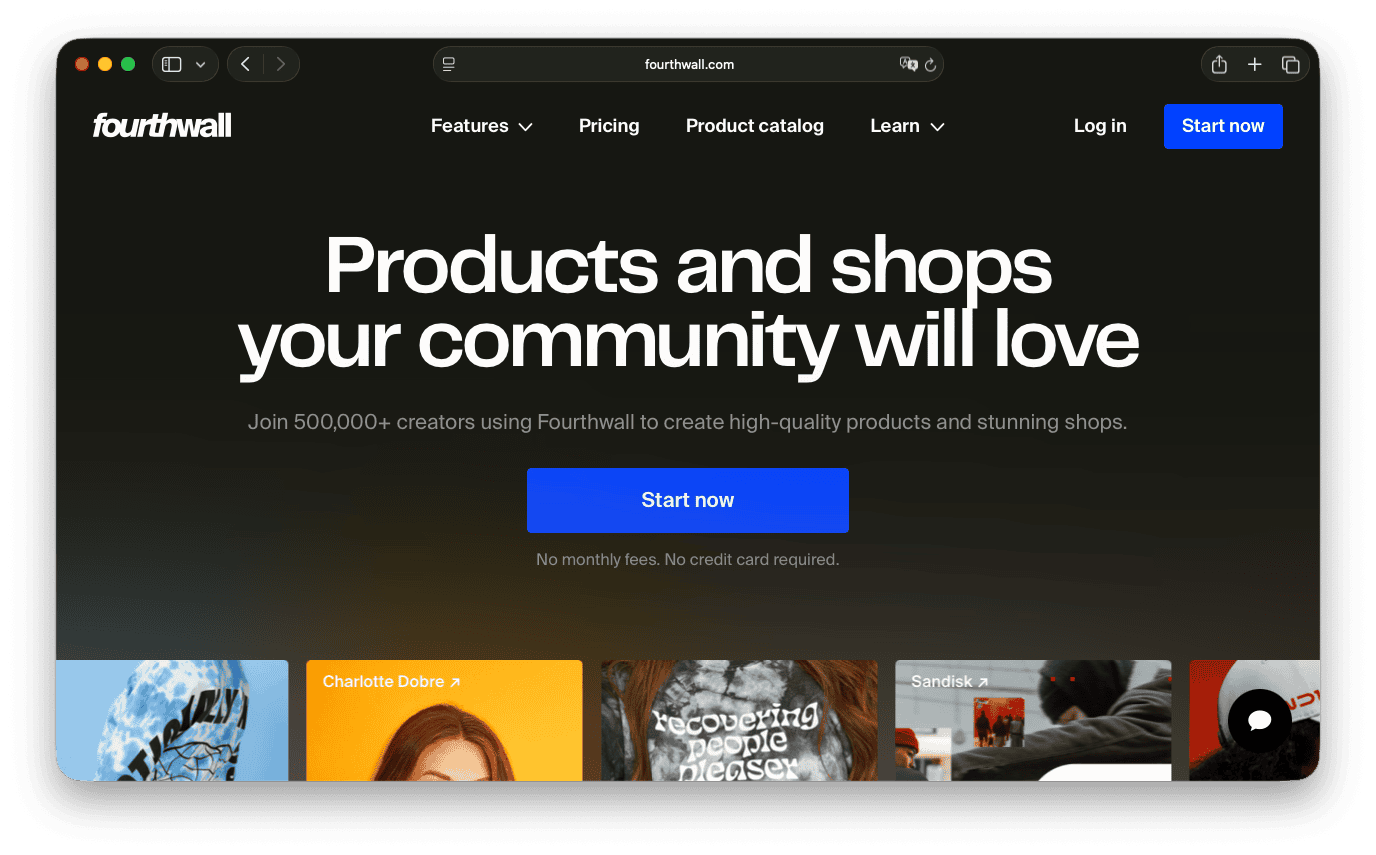
It’s an eCommerce platform designed for creators who want to run a branded online store without managing production or logistics themselves.
Fourthwall combines storefront tools with print-on-demand fulfillment, allowing sellers to design and sell merchandise while production, packaging, and shipping are handled through fulfillment partners.
For creators weighing Fourthwall against going straight to a fulfillment provider, one reviewer summed up the appeal on TrustPilot:
The product catalog includes hundreds of customizable items, including apparel, accessories, home goods, and drinkware. Designs can be applied using several printing methods, such as direct-to-garment (DTG), embroidery, screen printing, direct-to-film (DTF), and sublimation, depending on the product and supplier.
Fourthwall also supports additional revenue streams beyond physical merchandise. Creators can sell digital downloads, memberships, and other content directly through their storefront, while built-in tools help manage payments, customer orders, and store analytics.
Pros of Fourthwall
- Branded storefront with full control over design and layout
- Merchant of Record handles sales tax and VAT for you, so you don't collect or remit them yourself
- Multiple revenue streams in one place, like merchandise, digital products, memberships, and tips
- Native platform integrations, including TikTok Shop, YouTube Merch Shelf, and Twitch
- Multiple printing methods, including DTG, embroidery, screen printing, DTF, and sublimation
- Global fulfillment across major regions, including the US, UK, EU, and Australia
Cons of Fourthwall
- No built-in marketplace for product discovery, so you bring your own audience
- Built for on-demand rather than high-volume bulk or wholesale runs, so large-quantity manufacturing isn't its strength
- Limited niche printing methods
Fourthwall vs Printify: Pricing Breakdown
On their free plans, Printify's per-shirt cost is slightly lower. Fourthwall includes the storefront and sales tax handling at no extra cost. Once you add the tools you need to actually sell through Printify, the total comes out higher.
Here's what selling a Bella+Canvas tee at $25 costs on each free plan, at 25 and 100 orders a month:
On the free plans, Fourthwall comes out cheaper at both volumes: about $67 less at 25 orders a month and $32 less at 100. Printify saves you $0.46 per shirt, but you'd need to sell around 170 shirts a month before that covers the $78 you'd pay for a storefront and tax tool.
Printify's Premium plan ($39/month) lowers this tee to $9.04, making Printify the cheaper option once you pass roughly 43 orders a month. It's worth running that math if you already sell at volume.
The cost gap is only part of the decision. With Printify, you still run the storefront, keep the tax tool configured, and handle customer support yourself. Fourthwall covers all three, and it lets you sell memberships and digital products from the same store.
A Summary of Fourthwall's Trustpilot Reviews
Trustpilot reviewers overwhelmingly report a great experience with Fourthwall. They single out the platform design, saying the website and store builder make it easy for beginners to set up and run a store. Support also stands out, with reviewers calling the team quick to respond, helpful, and professional.
Fourthwall Pricing
Fourthwall is free to use with no monthly fee, and you're not charged until you make a sale. There's no cost to build a fully branded store, sell physical and digital products, and run memberships.
Instead of a subscription, Fourthwall earns the difference between production and the base cost you pay on catalog products, so you keep 0% platform fee on physical merch: you set the retail price and keep the full margin above base cost.
The other costs to know are card processing at 2.9% + $0.30 per transaction, a 5% fee on memberships, and a 5% fee on digital products (which drops to 0% on the Pro plan).
Fourthwall has two plans:
- Free ($0/month): the full toolkit, including your storefront, physical and digital products, memberships, and tips, with Fourthwall handling production, shipping, support, and taxes as Merchant of Record.
- Pro ($19/month, or $180/year): everything in Free, plus a 0% digital-product fee, higher product and team limits, priority support, and a free domain.
2. Gelato
Average customer rating: Trustpilot: 4.2 (3.3K+ reviews)
Gelato is the best Printify alternative for sellers who already have a store and just need a fulfillment backend.

It’s a global print-on-demand platform that connects online sellers with a network of more than 250 production partners across 32 countries.
Orders are automatically routed to the printing facility closest to the customer, enabling local production and faster delivery in many regions.
Gelato offers a broad catalog of customizable products spanning categories such as apparel, wall art, drinkware, home goods, and accessories.
Products can be printed using techniques such as direct-to-garment (DTG), embroidery, dye-sublimation, and other digital printing methods, while built-in design tools and integrations with eCommerce platforms help sellers create products and automate order fulfillment.
Pros of Gelato
- Local production network spanning multiple countries
- Faster shipping in many international markets
- Consistent print standards across partner facilities
- Product personalization tools available
- Pricing tools to help estimate margins
Cons of Gelato
- No built-in storefront, so you connect your own store to sell
- Product catalog smaller than some large POD marketplaces
- Some advanced features locked behind a paid Gelato+ plan
- No phone support, only 24/7 chat and Help Center
A Summary of Gelato's Trustpilot Reviews
Trustpilot reviewers overwhelmingly report a great experience with Gelato, praising how easy it is to set up a store and publish products without holding stock. They also highlight responsive support, clear answers, and reliable product quality. A smaller share of reviewers flagged unexpected shipping delays.
Gelato Pricing
Gelato is free to use, and you only pay the product base cost plus shipping when an order comes in. If you want lower costs, the optional Gelato+ plan runs about $29.99/month (or $19.99/month billed annually) for product discounts and extra tools, with a 14-day free trial and a custom enterprise tier for high-volume sellers.
3. CustomCat
Average customer rating: Shopify App Store: 4.6 (110+ reviews)
CustomCat is the best Printify alternative for U.S.-based sellers who prioritize fast domestic fulfillment and margins.
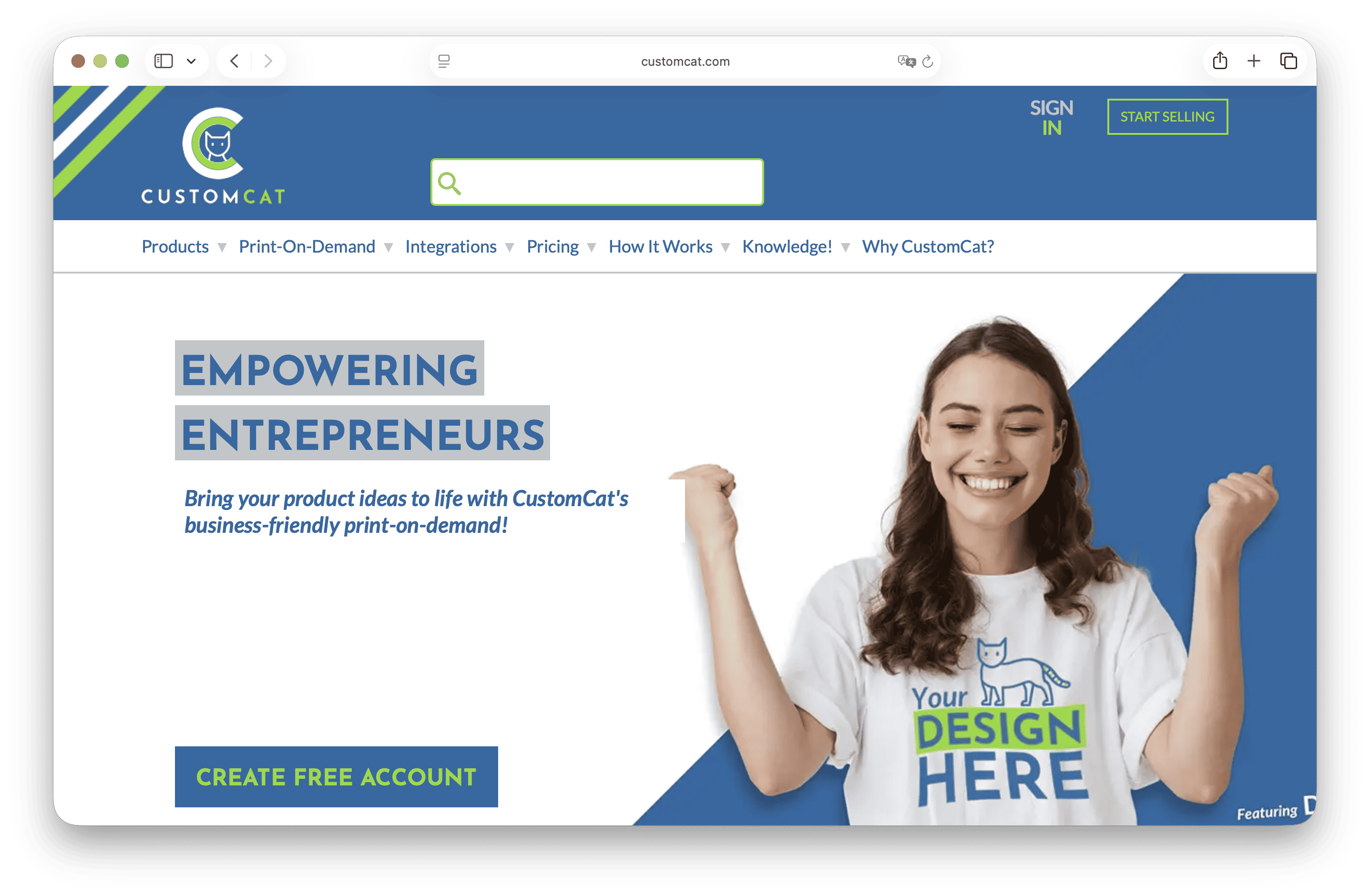
It’s a U.S.-based print-on-demand fulfillment platform that produces and ships custom merchandise for online sellers.
Unlike supplier-marketplace models, CustomCat runs its own production infrastructure, processing orders in-house through a centralized manufacturing system in Detroit. This single-location model enables fast domestic fulfillment, though it can mean longer delivery times for international or distant orders.
The platform offers a catalog of hundreds of customizable products, with a strong focus on apparel from over 50 established brands, like Bella+Canvas, Gildan, Hanes, Port & Company, and Adidas.
Pros of CustomCat
- Fast U.S. fulfillment, often shipping within 1–3 business days
- Catalog of hundreds of customizable products
- Access to well-known apparel brands
- Multiple professional printing methods available
- Bulk publishing tools and API access for scaling stores
- Phone, email, and chat support available
Cons of CustomCat
- Limited branding options, with no custom packaging or labels (items ship with original brand tags)
- Basic design and mockup tools
- No built-in storefront or marketplace
- International shipping may take longer than domestic orders
A Summary of CustomCat's Shopify App Store Reviews
Merchants describe CustomCat as a reliable partner with high-quality prints that stay vibrant, especially with its DigiSoft printing method. They like the brand-name blanks, wide catalog, fast fulfillment, and smooth Shopify integration, and many single out responsive, personal support. Some merchants mention the Pro subscription fee, though they say the pricing still improves their margins.
CustomCat Pricing
CustomCat is free to use on its Lite plan, with no upfront cost and payment only when an order comes in for the product base cost plus shipping. To boost margins, the optional Pro plan is $30/month (or $25/month billed annually), unlocking 20 to 40% off product costs, with a custom Enterprise tier for high-volume sellers.
If you're looking for a cheaper alternative to Printify, the Pro plan is where CustomCat gets there, since those catalog discounts can drop a typical product below Printify's base cost once you're selling enough each month to offset the subscription.
4. Spreadshirt
Average customer rating: Trustpilot: 3.9 (16K+ reviews)
Spreadshirt is the best alternative to Printify for designers and small brands who want marketplace exposure.

It’s a print-on-demand platform that lets users upload designs and sell them on customizable products without managing production or shipping. It operates as both a print provider and an online marketplace, where creators can list designs for sale and earn a commission whenever one sells.
Spreadshirt’s catalog includes over 250 customizable items across categories such as apparel, accessories, and drinkware, produced in facilities in the United States and Europe for localized fulfillment.
Beyond marketplace listings, users can open a free standalone storefront, Spreadshop, to sell products under their own brand, logo, and pricing.
Creators often run that shop alongside their existing channels.
Pros of Spreadshirt
- Built-in marketplace with existing customer traffic
- Free storefront option through Spreadshop
- Automated production and fulfillment in the U.S. and EU
- Offers organic and eco-friendly apparel options
- Integration with YouTube Merch Shelf
Cons of Spreadshirt
- Marketplace sales pay a fixed commission, so margins there are lower than platforms where you set your own price (Spreadshop, by contrast, lets you set your own markup)
- Limited storefront branding and customization options
- Customer data from marketplace purchases isn't fully accessible to sellers
- Smaller product catalog than some larger POD providers
A Summary of Spreadshirt's Trustpilot Reviews
Trustpilot reviewers report a great experience with Spreadshirt, praising print quality, with vibrant colors and sharp graphics that match what's shown online. They also find the website easy to navigate and say orders arrive promptly. A smaller share of reviewers reported delivery delays.
Spreadshirt Pricing
Spreadshirt is free to use with no monthly fees. On the marketplace, you earn a fixed commission per sale, while a free Spreadshop lets you set your own markup above the product base cost and keep the difference. Either way, the per-order base cost is what mainly shapes your margin.
5. Zazzle
Average customer rating: Trustpilot: 4.4 (29K+ reviews)
Zazzle is the best Printify alternative for designers and hobbyists who want passive royalty income from a large built-in marketplace, especially for gifts and event products.

It’ss a print-on-demand marketplace that lets creators upload designs and sell them on customizable products without managing production or fulfillment.
Zazzle leans heavily into personalization, letting customers modify designs directly through an online editor before placing an order.
Its catalog spans more than 1,000 customizable products across apparel, home décor, stationery, accessories, and gift-oriented items commonly used for events such as weddings, birthdays, and corporate occasions.
Zazzle operates as a marketplace with an established global user base, so creators can list products and earn royalties from sales while the platform handles manufacturing, shipping, and customer service.
Pros of Zazzle
- Built-in marketplace with a large global customer base
- Strong product personalization tools with real-time editing
- Catalog of 1,000+ customizable products
- Fulfillment, shipping, and customer service handled by the platform
- Well-suited for event-driven and gift-oriented products
Cons of Zazzle
- Limited branding control and storefront customization
- Competitive marketplace with many sellers
- Royalty-based earnings can result in lower profit margins
- Promotions and discounts may affect royalty payouts
A Summary of Zazzle's Trustpilot Reviews
Trustpilot reviewers overwhelmingly report a great experience with Zazzle, calling its design tool seamless for personalizing items like mugs and invitations. Many are impressed by product quality, from vibrant colors and clear images to durable materials. A small share of reviewers flagged occasional print flaws, such as blurry text or misaligned designs.
Zazzle Pricing
Zazzle is free to create and sell on, with no seller subscription. You set a royalty rate on top of each product's base price and earn that margin when it sells, while Zazzle handles production and fulfillment. The base cost per item is the real driver of your take-home, not any plan fee.
6. Printful
Average customer rating: Trustpilot: 4.2 (7.8K+ reviews)
Printful is the best Printify alternative for sellers who want premium print quality and deep branding control to power their own store on Shopify, Etsy, or another platform.

The company owns and operates its production facilities, which allow it to oversee manufacturing directly and maintain consistent quality across fulfillment centers.
Printful’s catalog spans more than 500 customizable products across apparel, accessories, and home goods, using printing methods that include direct-to-garment (DTG), embroidery, sublimation, direct-to-film (DTF), and cut-and-sew production.
Printful also includes free design tools, branding options like inside labels and pack-ins, and integrations with major eCommerce platforms to automate order fulfillment.
Pros of Printful
- In-house production facilities help maintain consistent product quality
- Catalog of 500+ customizable products
- Multiple printing methods, including DTG, embroidery, sublimation, and DTF
- Branding options such as custom labels, pack-ins, and white-label shipping
- Advanced mockup generator and design tools
- Integrates with major ecommerce platforms
Cons of Printful
- Base product pricing can be higher without membership or volume discounts
- Built-in storefront (Quick Stores) is basic and US-only, so most sellers connect an external store
- Doesn't support digital product or membership sales natively
- Customer support is limited to chat and email (no phone support)
A Summary of Printful's Trustpilot Reviews
Trustpilot reviewers report a great experience with Printful, describing the website as easy to navigate and store management as hassle-free. They praise its integrations with popular eCommerce platforms, its large selection of customizable products, and the design tools that help bring ideas to life. Some reviewers reported significant shipping delays on urgent orders.
Printful Pricing
Printful is free to use, and you only pay the product base cost plus shipping per order. The optional Growth membership costs $24.99/month for up to 33% off product costs, and it's free for a year once you pass $12,000 in sales.
7. Tapstitch
Average customer rating: Trustpilot: 4.3 (530+ reviews)
Tapstitch is the best Printify alternative for creators building a premium streetwear or fashion apparel brand who want retail-quality blanks without minimums.

It’s a print-on-demand platform built specifically for clothing brands, focused on premium, fashion-grade apparel.
Tapstitch owns its manufacturing, which lets it offer heavyweight blanks, modern streetwear fits, and large print areas designed to compete at higher retail price points.
Its catalog is apparel-only, so it skips mugs, phone cases, and home goods entirely and leans into premium tees, high-GSM hoodies, and oversized cuts with retail-ready quality.
Orders are produced and shipped with no Tapstitch branding on the package, and customizable, eco-friendly packaging is available.
Designs are applied using direct-to-garment (DTG) and direct-to-film (DTF) printing, and Tapstitch integrates with major eCommerce platforms like Shopify, Etsy, WooCommerce, and Wix to sync products and automate fulfillment once an order comes in.
Pros of Tapstitch
- Fashion-grade apparel blanks built for higher retail price points
- Retail-ready print and product quality, owned manufacturing rather than a third-party network
- No order minimums and no subscription to start
- Branded, eco-friendly packaging with no platform branding on the package
- Integrates with Shopify, Etsy, WooCommerce, and Wix
Cons of Tapstitch
- Apparel only, with no mugs, accessories, or home goods
- Limited print methods, only DTG and DTF (no embroidery, sublimation, or all-over print)
- International shipping from its China facility can be slow, with longer delivery times on some orders
A Summary of Tapstitch's Trustpilot Reviews
Trustpilot reviewers overwhelmingly report a great experience with Tapstitch, praising its print quality, vibrant colors, and comfortable fabric. They also find ordering straightforward and delivery fast. Some reviewers found that garments ran small.
Tapstitch Pricing
Tapstitch is free to use with no subscription or setup fee, and you only pay per order for the base item, print charges, and shipping. There are no order minimums, so costs scale entirely with sales, and shipping is charged as a base rate for the first item plus a smaller fee for each additional item in the same order.
8. Gooten
Average customer rating: Trustpilot: 3.1 (220+ reviews)
Gooten is the best Printify alternative for eCommerce sellers and growing brands who want a hands-off, automated fulfillment backend connected to their own store, not creators looking for a built-in storefront.

As a print-on-demand fulfillment platform, Gooten connects eCommerce businesses with a global network of manufacturing partners.
The platform routes each order automatically to the best-fit production partner by location, capacity, and delivery speed, so sellers don't have to pick providers or manage supplier relationships themselves.
Gooten also integrates with major eCommerce platforms, so orders are automatically sent to production partners once a purchase is made. This lets sellers focus on managing their storefront and customer experience while fulfillment runs in the background.
Pros of Gooten
- No monthly platform fees
- Automated order routing across production partners
- Strong integrations with eCommerce platforms
- Designed to handle growing order volumes
- Competitive base pricing on common product categories
Cons of Gooten
- Limited tools for creators selling directly to fans
- Dashboard can require time to learn for new users
- Basic branding customization options
- Mockup generation tools are relatively simple
A Summary of Gooten's Trustpilot Reviews
Most Trustpilot reviewers are fairly happy with Gooten, pointing to a user-friendly platform, smooth store integrations, and clear setup guides. Many also like the quality of products such as woven blankets and decorative pillows. Some reviewers reported long order delays, with shipments stuck in production.
Gooten Pricing
Gooten has no setup or monthly fees. You only pay the product base cost plus shipping when an order is manufactured and shipped, with volume discounts that improve as you scale.
9. Redbubble
Average customer rating: Trustpilot: 4.4 (55K+ reviews)
Redbubble is the best Printify alternative for hobbyists and independent artists who want hands-off, passive exposure to a large built-in audience, especially for stickers and fandom-style designs, treated as one income stream among several rather than a primary business.

It’s a print-on-demand marketplace where artists upload original designs, which are automatically applied to a wide range of products without managing inventory or fulfillment.
Redbubble supports more than 70 customizable items, including apparel, stickers, wall art, phone cases, and home décor, letting creators distribute a single design across multiple product categories.
Once a product is purchased, Redbubble oversees production, shipping, returns, and customer support, while the artist earns a margin based on the markup they set above the base product price.
As of September 2025, Redbubble also runs a tiered account system (Standard, Premium, and Pro) that determines the platform fee deducted from an artist's earnings, which significantly affects take-home pay.
Pros of Redbubble
- Built-in global marketplace with significant organic traffic
- Fully managed fulfillment, shipping, and customer support
- No upfront costs or inventory requirements
- Quick product listing process after uploading designs
- Strong demand for items such as stickers, apparel, and fandom-themed merchandise
Cons of Redbubble
- Standard-tier accounts (the default) pay a 50% platform fee on monthly earnings since September 2025, sharply cutting margins. Only Premium (20%) and Pro (0%) tiers pay less.
- Limited branding and storefront customization options
- Smaller product catalog compared with some supplier-network POD platforms
- Competitive marketplace can make visibility challenging
- Upload limits may affect high-volume design publishers
A Summary of Redbubble's Trustpilot Reviews
Trustpilot reviewers overwhelmingly report a great experience with Redbubble, praising the variety of unique designs and fast, reliable delivery. They also find browsing and ordering straightforward, and say products like shirts and stickers often exceed expectations. A small share of reviewers flagged blurry or pixelated artwork on some items.
Redbubble Pricing
Redbubble is free to open an account and list products, with nothing to pay until a sale. Rather than a subscription, it charges a tiered platform fee on your earnings: 50% for Standard accounts, 20% for Premium, and 0% for Pro. Your margin is whatever markup you set above the base price, minus that fee.
How to choose the right Printify alternative
The fastest way to choose an alternative to Printify is to match your situation to a scenario rather than score feature tables.
If you already have an audience, the calculation is different. Your traffic isn't the problem to solve, so the real question is whether you get to own the relationship with the fans you bring. Marketplaces borrow your audience and keep the customer, while backend tools make you drive the traffic and stop at fulfillment, leaving you to stitch the storefront, payments, and taxes together yourself. Fourthwall is the only Printify alternative on this list that gives you both a branded store you own and the back office handled for you.
FAQ
Fourthwall is the Printify alternative that handles production, shipping, and customer support and also acts as Merchant of Record, meaning Fourthwall takes on sales tax and VAT collection and remittance. Most other Printify alternatives cover only fulfillment and shipping, leaving tax responsibility with the seller unless the platform is the merchant of record, which is uncommon among print-on-demand providers.
Printify uses a network of independent print providers, so quality varies by supplier, while alternatives like Printful, Tapstitch, and Fourthwall rely on tighter production networks with more consistent standards. Printful runs in-house facilities for direct-to-garment and embroidery, Tapstitch owns manufacturing for retail-grade streetwear apparel, and Fourthwall vets its fulfillment partners and handles qualifying replacements on catalog orders it produces.
CustomCat is the Printify alternative most focused on fast US shipping, with domestic fulfillment out of American facilities and lower base costs on apparel. Fourthwall and Printful also fulfill many US orders locally, while Gelato routes production to the closest of its facilities in 32 countries, which usually keeps international delivery windows shorter than a single US-based provider shipping worldwide.
Gelato, Gooten, CustomCat, and Printful are the strongest Printify alternatives for Etsy sellers, because each connects directly to Etsy so paid orders route to fulfillment automatically without a middleware app. Printful runs its own production network for consistent US and EU fulfillment, CustomCat focuses on fast US shipping, and Gelato routes production to the printer nearest the buyer across 32 countries. Fourthwall does not plug into Etsy but works alongside it as a branded storefront for creators who want their own shop.
Fourthwall, CustomCat, Gelato, Gooten, and Spreadshirt all have no required monthly fee, so Printify alternatives can launch a store without a subscription. Fourthwall's Free plan charges 0% on physical merch margin (production, shipping, and payment processing come out of each sale), with an optional Pro plan at $19 per month. Printful and Printify themselves also offer free tiers, though each has a paid subscription that unlocks catalog discounts.
Richard is Head of Organic Growth at Fourthwall, with 14+ years of experience in the creator economy and ecommerce. He’s built businesses across the spectrum—from print-on-demand stores to custom cut-and-sew clothing lines, as well as selling digital products. He helps creators navigate merch strategy and build sustainable businesses.


You might also like

How to Create and Sell Print on Demand Journals and Notebooks

9 Gumroad Alternatives for Digital Creators in 2026

10 Best Stan Store Alternatives for Creators in 2026

9 Best Patreon Alternatives for Creators in 2026

20 Sustainable Swag Ideas for Events and Giveaways

8 Best Gelato Alternatives for Print-on-Demand in 2026

TikTok Affiliate Marketing: How It Works and How to Make Money

9 Best Redbubble Alternatives for Print-on-Demand Creators in 2026

The Top Celebrity Clothing Brands and Why They Succeeded


Keep up with the latest from Fourthwall
New features, product updates, trend breakdowns, and creator stories — straight to your inbox.