
8 Best Etsy Alternatives for Online Store Owners in 2026
Compare fees, features, and fit across 8 Etsy alternatives to find the platform that matches how you sell.


The best Etsy alternatives in 2026 are Fourthwall, Amazon Handmade, Shopify, eBay, Big Cartel, Society6, Bonanza, and Storenvy. Fourthwall is the top pick for sellers who want a branded storefront with merch, memberships, and digital products in one place, no monthly fee to start, and Fourthwall handling sales tax as Merchant of Record. Etsy may not suit sellers facing its 6.5% transaction fee, $0.20 listing fee, and non-optional Offsite Ads once sales cross a threshold.
Etsy built its reputation as the default marketplace for handmade, vintage, and creative goods, and for many sellers, it still is. It has millions of buyers already searching for the kinds of things you make, and getting a shop live takes minutes.
But there’s a compromise you make when using Etsy. The platform’s economics and the seller experience have both dramatically changed over the past few years.
The 6.5% transaction fee stacks on top of a $0.20 listing fee, payment processing, and non-optional Offsite Ads once you cross a sales threshold. The marketplace is saturated, storefront customization is limited, and you don't own the customer relationship at the end of it.
Scroll through r/Etsy or r/EtsySellers, and you’ll find that the recurring theme from experienced sellers is that no single "Etsy replacement" exists. The right alternative depends entirely on what you sell and how you want to grow.
In this guide, we'll explore 8 of the best Etsy alternatives for online store owners, so you can find the one that fits your product, your margins, and your ambitions.
Etsy Alternatives at a Glance
1. Fourthwall
Average customer rating: Trustpilot: 4.3 (350+ reviews)
Fourthwall is the best Etsy alternative for online store owners who want a fully branded shop where merch, digital products, and memberships live in one place, without running a booth on someone else's marketplace.
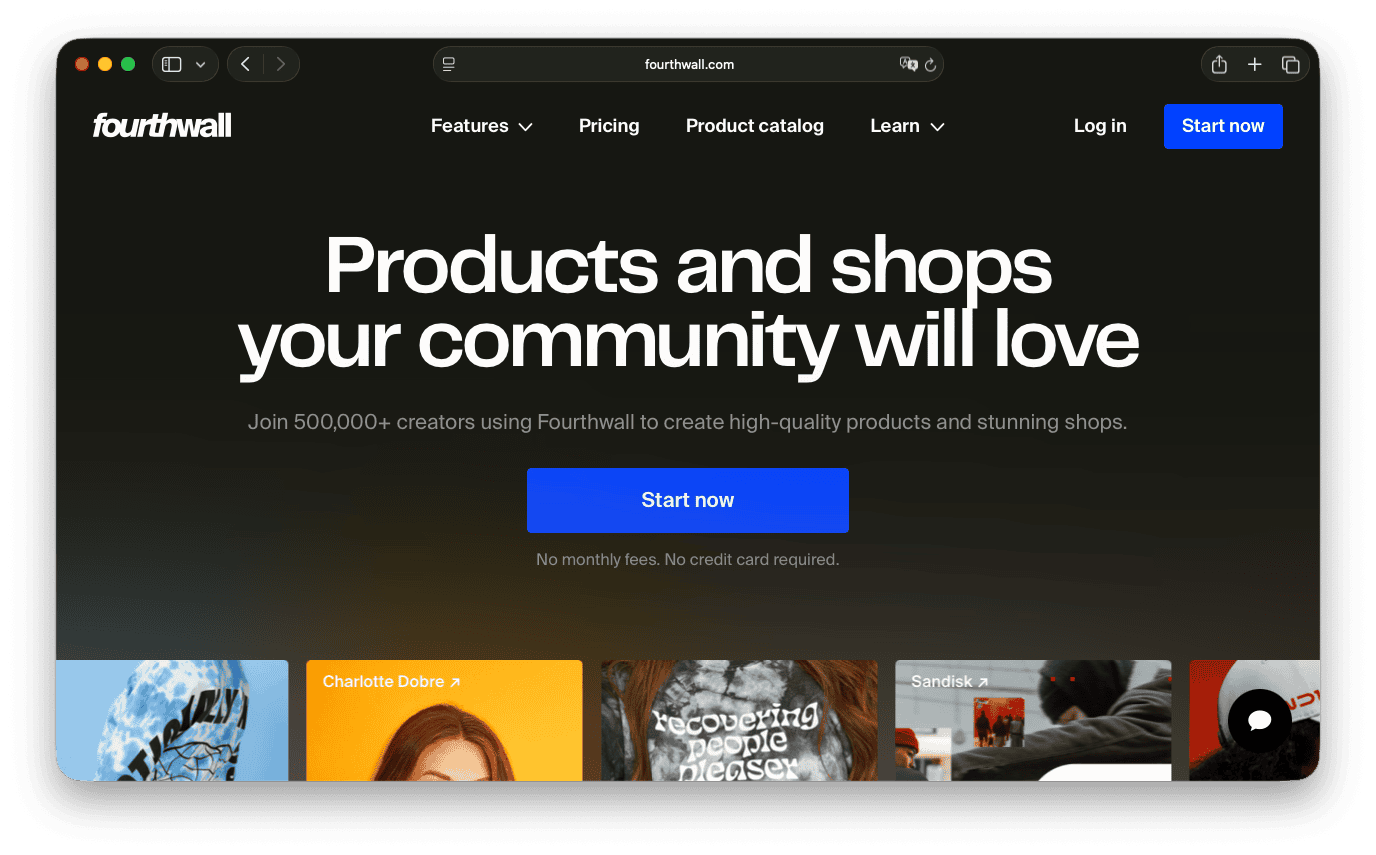
It's an all-in-one commerce platform for creators and independent sellers. You get a hosted, custom-branded storefront with your own domain, a no-code website builder, and hundreds of customizable print-on-demand products across apparel, accessories, home goods, and drinkware. Items are produced after a customer orders, so there's no inventory to buy up front and no minimums.
Beyond physical merch, you can sell digital downloads, run tiered memberships with members-only content and Discord roles, and accept donations, all from the same store. For applicable transactions processed through the platform, Fourthwall acts as the Merchant of Record and handles sales tax and VAT collection and remittance for you.
For sellers weighing Fourthwall against building a store yourself, one reviewer put it plainly:
Pros of Fourthwall
- Fully branded storefront with your own domain, no marketplace layout to fight
- Merchant of Record handles sales tax and VAT on eligible transactions
- Multiple revenue streams in one place: merch, digital products, memberships, and tips
- Hundreds of catalog products with no order minimums or inventory risk
- End-customer support handled by Fourthwall for Fourthwall-produced catalog orders
- Native integrations with YouTube Merch Shelf, TikTok Shop, Twitch, and Klaviyo, and 20+ more
Cons of Fourthwall
- No built-in marketplace traffic, so you need to bring your own audience
- Best suited to on-demand production rather than large bulk or wholesale runs
- Not built for pure resale or vintage the way marketplace-style platforms are
A summary of Fourthwall’s Trustpilot reviews
Across 350+ reviews, reviewers consistently highlight how simple it is to build a storefront and customize products, along with fast, helpful customer support for everyday questions. A small minority note occasional issues with support responsiveness on urgent matters or with production and shipping accuracy.
Fourthwall Pricing
Fourthwall is free to open with no monthly subscription fee.
On the Free plan, there's:
- No platform cut on physical merch
- A 5% fee on memberships
- A 5% fee on digital products
- 0% on donations
- Card processing at 2.9% + $0.30 per transaction.
The Pro plan is $19 per month, or $15 per month billed annually, and drops the digital-product fee to 0% while adding a $10 monthly sample credit, a free domain benefit, and higher limits.
Etsy vs. Fourthwall: Fee Breakdown on a $100 Sale
On a $100 sale, Etsy's combined listing, transaction, and processing fees run close to $10. Fourthwall's Free plan carries only card processing, putting its fee stack at roughly a third of Etsy's:
2. Amazon Handmade
Amazon Handmade is the best alternative to Etsy for handmade sellers who want direct access to Amazon's built-in buyer demand and are willing to be approved into a curated program.
.png)
It's a curated section of Amazon reserved for verified artisans. You apply, submit information about how your products are made, and once you're approved, you list handcrafted items alongside the rest of the Amazon catalog.
Approved sellers get their own Maker profile page and access to Amazon Seller Central for managing listings, orders, and analytics.
Amazon Handmade is a marketplace, not a branded storefront. That means you sell inside Amazon's ecosystem, and Amazon owns the customer relationship and the discovery layer. In exchange, you plug into a shopper base that already trusts Amazon's checkout and returns experience, and you can optionally use Fulfillment by Amazon (FBA) so Amazon stores, packs, and ships your inventory.
Pros of Amazon Handmade
- Massive built-in buyer base compared with most niche marketplaces
- No monthly Professional selling fee after the first month for approved Handmade sellers
- Optional FBA fulfillment offloads storage, packing, and shipping to Amazon
- High buyer trust and Prime eligibility on qualifying products
Cons of Amazon Handmade
- Handmade-only approval process can be slow and rejects mass-produced or resale items
- You don't own the customer relationship, and re-marketing outside Amazon is restricted
- Storefront customization is minimal compared with running your own branded shop
What Etsy Sellers Say About Amazon Handmade on Reddit
Across a Reddit thread of Etsy and POD sellers, sentiment on Amazon Handmade is mixed. Some report stronger sales than Etsy thanks to its larger buyer base, while others cite a difficult interface, low visibility for new listings, and slow support. Results varied widely by product category and seller experience.
Amazon Handmade Pricing
Amazon Handmade pricing breaks down as follows:
- Professional selling account: $39.99/month, waived starting the second month for approved Handmade sellers, bringing the effective ongoing cost to $0/month
- Referral fee: 15% per sale, or $0.30 per item, whichever is greater
- FBA fulfillment and Amazon Ads: optional, billed separately
3. Shopify
Average customer rating: G2: 4.4 (5K+ reviews)
Shopify is the best Etsy alternative for sellers building an independent, scalable brand who need deep customization and a large app ecosystem.

Shopify is a fully hosted ecommerce platform rather than a marketplace.
You get your own domain, mobile-friendly storefront themes, a huge app store for extending functionality, and tools for inventory, shipping, and multi-channel selling across Amazon, eBay, TikTok, Instagram, and your own site. Shopify POS handles in-person sales and keeps inventory synced.
Shopify gives you the storefront, but you don’t get buyers. You have to drive your own traffic through SEO, ads, email, or social, and you'll typically stitch together POD, memberships, or digital-product functionality through third-party apps rather than getting them natively. That's a strength if you want granular control, and an operational cost if you don't.
Pros of Shopify
- Deep customization and a massive app ecosystem with thousands of integrations
- Multi-channel selling across your own site, marketplaces, and social platforms
- Shopify POS for combining in-person and online sales with synced inventory
- Strong support for scaling operations and complex inventory catalogs
Cons of Shopify
- Monthly subscription regardless of sales volume, unlike Etsy's per-sale fee model
- POD, memberships, and digital products usually require paid apps, adding cost and complexity
- You bring your own traffic, so ranking and paid acquisition become part of the job
A summary of Shopify’s G2 reviews
Across 5,000+ G2 reviews, Shopify users consistently point to its ease of use and intuitive setup as standout strengths, along with the breadth of built-in features, like inventory management and app integrations, that streamline day-to-day store operations. The recurring downside is cost. Expenses can add up quickly once premium apps and transaction fees enter the picture.1
Shopify Pricing
Shopify offers a 3-day free trial, then $1/month for the first 3 months.
After that, pricing runs:
- Basic: $39/month ($29/month billed annually)
- Grow: $105/month ($79/month billed annually)
- Advanced: $399/month ($299/month billed annually)
- Shopify Plus: starts at $2,300/month
Card rates via Shopify Payments run from 2.9% + $0.30 on Basic down to 2.5% + $0.30 on Advanced. Third-party payment gateways add another 0.6% to 2% on top, depending on plan.
4. eBay
eBay is the best alternative to Etsy for sellers who want to test demand or move vintage, collectible, and one-off items to a huge global marketplace.

eBay is one of the oldest online marketplaces and remains one of the largest by seller and buyer volume. It supports both auction-style and fixed-price listings across almost every product category, including handmade goods, apparel, electronics, collectibles and a lot more.
You can operate as an individual seller or upgrade to an eBay Store subscription for higher listing limits and branding tools.
eBay isn't handmade-focused the way Etsy or Amazon Handmade are, so the buyer intent is different. Shoppers come for deals, rare finds, and specific items rather than curated craft.
That makes it a strong secondary channel for testing what sells or moving product that doesn't fit a handmade-only marketplace, and a weaker fit if the story behind your work is a core part of the pitch.
Pros of eBay
- 250 free listings per month in most categories, so listing volume costs little
- Huge global buyer base with strong existing search visibility
- Auction and fixed-price options give you flexibility on how to price
- Category breadth, so vintage, collectibles, and general goods all fit
Cons of eBay
- Final value fees are category-dependent and can run up to 15.3%, higher than Etsy's headline rate
- Not handmade-focused, so craft buyers don't naturally search there
- Limited storefront branding unless you upgrade to a paid eBay Store subscription
What Etsy Sellers Say About eBay on Reddit
Across a Reddit thread of Etsy sellers, sentiment on switching from Etsy to eBay is mixed. Some report stronger earnings, faster sales, and better support on eBay, while others cite weaker seller protection and a strong bias toward buyers in dispute resolution.
eBay Pricing
eBay pricing breaks down as follows:
- Listings: 250 zero-insertion-fee listings per month, then $0.35 per additional listing (category exclusions apply)
- Final value fees: 2.5% to 15.3% depending on category, plus a per-order fee of $0.30 for orders of $10 or less and $0.40 for orders above $10
- eBay Store subscriptions (optional): start at $4.95/month billed annually, adding higher listing allowances and basic branding tools
5. Big Cartel
Average customer rating: Trustpilot: 4.7 (370+ reviews)
Big Cartel is the best Etsy alternative for independent artists and small brands with a tight catalog who want a simple standalone shop rather than a marketplace booth.

Big Cartel is a lightweight ecommerce platform built specifically for artists, makers, and small creative brands. You get a hosted storefront with basic themes, a mobile-friendly layout, and enough tools to sell without a learning curve.
For sellers who want print-on-demand alongside their own products, Big Cartel connects to Printful, Printify, and other POD services.
Big Cartel doesn't take a percentage cut on sales, so your only per-order costs are payment processing through Stripe or PayPal and whatever base costs your POD partner charges.
Pros of Big Cartel
- Free plan for up to 5 products, useful for testing an idea before scaling
- No platform commission on sales, only standard Stripe or PayPal processing fees
- Print-on-demand integrations with Printful and Printify built in
- Custom domain support even on paid plans
Cons of Big Cartel
- Product and feature limits mean you'll outgrow it as your catalog expands
- Basic storefront themes with limited design flexibility compared with Shopify
- No built-in marketplace traffic, so you're driving your own audience
A summary of Big Cartel’s Trustpilot reviews
Across 370+ reviews, reviewers were happy with how easy the platform is to set up and use, even without technical experience, along with affordable, transparent pricing and helpful customer support. A smaller group of reviewers noted some confusion following recent layout changes and would like more advanced customization or pricing flexibility for growing stores.
Big Cartel Pricing
Big Cartel pricing breaks down as follows:
- Gold: Free, with limited features
- Platinum: $15/month ($12/month billed annually), after a 7-day free trial
- Diamond: $30/month ($24/month billed annually)
Each paid tier unlocks higher product limits and additional store customization. Payment processing goes through Stripe or PayPal at their standard rates.
6. Society6
Average customer rating: Trustpilot: 3.6 (2K+ reviews)
Society6 is the best Etsy alternative for artists selling wall art, prints, and home decor who want a hands-off, print-on-demand marketplace and don't want to run a store, though it's worth noting upfront that Society6 isn't currently accepting new artist applications.

Society6 is a print-on-demand marketplace focused on art and home goods.
Artists upload designs, the platform applies them to a catalog of products like framed prints, canvases, throw pillows, apparel, and phone cases, and then handles all production, shipping, and customer support. You earn a royalty on each sale rather than setting a full retail markup.
In March 2025, Society6 moved to a curated approval model, and artist plans were eliminated during the transition. That change tightens the artist pool but also means some artists lost access to the platform and current terms may keep evolving. Verify current artist eligibility and payout structure on the official artist-account update before applying.
Pros of Society6
- No production or fulfillment work on your side once designs are uploaded
- Established art and home-decor buyer audience with curated marketplace intent
- Wide product range across prints, home goods, and accessories from a single design upload
- Fully managed customer service and returns handled by Society6
Cons of Society6
- Royalty-based earnings typically produce lower per-sale margins than platforms where you set the full price
- Limited branding and storefront control compared with running your own site
- Curated approval model since March 2025 limits how many artists get accepted
- Not currently accepting new artist applications. Reopening timeline is unconfirmed.
A summary of Society6’s Trustpilot reviews
Across 2,000+ reviews, reviewers frequently highlight creative designs, fast delivery, and friendly, helpful customer service. A notable share of reviewers report issues with print quality, including pixelated or blurry images and inaccurate colors, along with delivery delays, missing items, sizing problems, and difficulty reaching support for returns.
Society6 Pricing
Society6 is not currently accepting new artist applications. When submissions reopen, acceptance will go through a curation review rather than open enrollment.
As of March 18, 2025, Society6 sets pricing and markup rather than the artist:
- 10% markup: pillows, wall tapestry, framed art, and posters
- 5% markup: all other products
- Trade, wholesale, and marketplace orders: flat 5% commission
Shipping fees are no longer deducted from artist earnings.
7. Bonanza
Average customer rating: Trustpilot: 1.5 (1,800+ reviews)
Bonanza is the best Etsy alternative for sellers who want a low-fee marketplace with import tools from eBay and Etsy, plus Google Shopping reach.

Bonanza is a general-purpose marketplace with lower base fees than most of its competitors and a strong focus on making it easy to sync existing listings from eBay, Etsy, or Amazon.
The import-first approach makes it useful as a secondary channel rather than a primary one. You push your catalog in and Bonanza extends its reach through Google Shopping and its partner network.
The downside of it is that organic Bonanza traffic is modest compared with Etsy, Amazon, or eBay, so the low headline fee assumes you're driving some of your own visibility or paying for one of Bonanza's advertising tiers to unlock broader distribution.
Pros of Bonanza
- Easy imports from eBay, Etsy, and Amazon shorten setup
- Optional Google Shopping and partner-network advertising for extra reach
- No listing fees on the first 50 active listings
Cons of Bonanza
- Smaller organic buyer base than Etsy, Amazon, or eBay
- Advertising tiers raise the final value fee to 9%, 13%, or higher
- $14.99 one-time booth setup fee for new sellers
What Sellers Say About Bonanza on Reddit
On a Reddit thread, resellers highlight that Bonanza imports existing eBay listings automatically and requires little ongoing effort once set up, and even sellers with modest sales volume tend to view it as worthwhile since there's no cost unless an item sells.
On the downside, several sellers report unreliable syncing between eBay and Bonanza, including cases where items already sold on eBay were purchased again on Bonanza, along with limited organic traffic and shipping costs some found higher than expected.
Bonanza Pricing
Bonanza pricing breaks down as follows:
- Booth setup: one-time $14.99 fee for new sellers
- Transaction fee: $0.25 per sale (non-members)
- Final value fee: minimum 11% of the Final Offer Value (FOV) as of May 1, 2025, or higher depending on the advertising tier selected (up to 30%); minimum fee of $0.50
- Large orders: a flat 1.5% applies to the portion of FOV above $4,000
- Listing fee: for booths with more than 50 active listings, $0.03 per item/month on the excess, capped at $20/month
8. Storenvy
Average customer rating: Trustpilot: 1.3 (190+ reviews)
Storenvy is the best Etsy alternative for indie brands who want a free custom store plus an optional marketplace exposure layer for discovery.

Storenvy runs a dual model. You get a free custom store on your own subdomain (or a custom domain on a paid plan). If your products are approved, they can also appear inside the Storenvy Marketplace where shoppers browse.
The sales you make through your custom store cost you nothing beyond standard Stripe or PayPal processing. And sales that come through the marketplace pay a 15% commission.
That structure suits sellers who want to build a branded shop of their own but also want an optional discovery channel bolted on. Storenvy skews toward indie fashion, art prints, and design-forward products, so the marketplace audience is niche rather than mass-market.
Pros of Storenvy
- Free custom store with no monthly subscription on the base plan
- 0% platform commission on direct custom-store sales, only payment processing
- Marketplace discovery layer for optional built-in traffic
- Indie and design-forward audience for niche products
Cons of Storenvy
- 15% commission on marketplace-sourced sales eats into margin
- Smaller marketplace audience than Etsy or Amazon Handmade
- Buyer protections and seller reliability vary since Storenvy's marketplace is made up of independent, self-managed sellers
Storenvy Pricing
Storenvy offers four tiers, all with 20% off shown for annual billing:
- Free: $0/mo, up to 20 products, includes custom storefront and marketplace access (marketplace handling fees required)
- Artisan: $7.99/mo, up to 100 products, adds a free custom domain and removes storefront ads
- Growth: $19.99/mo, up to 500 products, adds automated engagement emails
- Professional: $39.99/mo, up to 5,000 products, adds no storefront handling fees
On paid tiers, marketplace handling fees become optional rather than required, and storefront ads are removed starting at Artisan. Marketplace sales carry a 15% commission on the total order value. Payment processing runs through Stripe or PayPal at standard rates (~2.9% + $0.30).
How to Choose the Right Etsy Alternative
Talk to any group of long-time Etsy sellers and the same theme keeps surfacing: there's no single Etsy replacement.
The right alternative depends on what you sell, whether you already have an audience, and how much you want to own the customer relationship.
Match your situation to a scenario rather than trying to score feature tables:
- Selling handmade goods and want to plug into an existing buyer base? Amazon Handmade brings the biggest audience but a stricter approval process and less brand control.
- Moving vintage, collectibles, resale, or one-off items? eBay suits that intent better than any craft-focused marketplace, and the fees are simpler to model.
- Building your own brand rather than borrowing a marketplace's? Shopify gives you the most technical control if you're comfortable driving your own traffic and paying for apps to fill feature gaps. Big Cartel is the lighter, cheaper option for a small catalog. Storenvy sits in between with a free custom store plus an optional marketplace layer.
But if you already have an audience, or you're a creator building one, the calculation is different. Marketplaces borrow your traffic and keep the customer at the end of the sale. Website builders hand you the storefront and leave you to stitch merch, memberships, digital products, taxes, and support together yourself.
Fourthwall is the Etsy alternative that gives you both a branded store you own and the back office handled for you. Physical merch, digital products, memberships, and Merchant of Record support in one place, with no monthly fee to start and no platform cut on your merch margins.
If that sounds like the right fit, start by building your storefront, adding your first product, and ordering a sample before going live.
FAQ
Etsy is usually the easier starting point for beginners because it comes with built-in buyer traffic and a shop can go live in minutes, while Shopify requires the seller to generate their own traffic through SEO, ads, or social channels. Shopify becomes the better choice once a seller wants to build a distinct brand with full control over design, pricing, and customer data. Many sellers start on Etsy to validate demand, then move to Shopify or Fourthwall once they have an audience worth owning directly.
Big Cartel and Storenvy are the cheapest Etsy alternatives for handmade sellers, with Big Cartel's Gold plan free for up to 5 products at 0% commission and Storenvy charging nothing on sales through your own custom storefront. Fourthwall's Free plan also has no monthly fee and 0% commission on physical merch margin, though its catalog is oriented around print-on-demand rather than fully handmade goods. Etsy itself charges a $0.20 listing fee plus a 6.5% transaction fee plus 3% + $0.25 payment processing, so most alternatives are cheaper per sale for handmade sellers.
Fourthwall natively supports digital downloads (ebooks, presets, printables, and courses) alongside physical merch and memberships, making it the strongest Etsy alternative for sellers whose catalog is digital-first. Shopify handles digital products only through third-party apps rather than a native workflow, so digital sellers pay for both a Shopify plan and an app subscription. Marketplaces like Amazon Handmade, eBay, and Bonanza are built for physical goods and lack a real digital-product delivery flow, so digital-focused sellers usually do better on Fourthwall or a purpose-built platform like Gumroad.
Etsy does not export shop reviews or follower lists in a format any other platform can import, so both are effectively lost when leaving Etsy for Shopify, Fourthwall, Amazon Handmade, or another alternative. Sellers can preserve social proof by screenshotting top reviews with reviewer permission and re-displaying them on the new store, and can move buyers manually by emailing past customers a launch announcement through Etsy's internal message system before switching. Product listings are exportable via Etsy's built-in CSV download.
Fourthwall is a strong Etsy alternative for creators who already have an audience, because it gives them a branded direct-to-fan storefront with print-on-demand merch, memberships, and digital products on a free plan with 0% commission on physical merch margin. Etsy is optimized for buyers browsing the Etsy marketplace, not for a creator sending existing fans off Instagram or YouTube to buy, so audiences already trained to buy from a creator convert better on a branded shop like Fourthwall than they do inside Etsy's marketplace UI.
Richard is Head of Organic Growth at Fourthwall, with 14+ years of experience in the creator economy and ecommerce. He’s built businesses across the spectrum—from print-on-demand stores to custom cut-and-sew clothing lines, as well as selling digital products. He helps creators navigate merch strategy and build sustainable businesses.


You might also like

8 Best TeePublic Alternatives for Artists in 2026

8 Best Printful Alternatives for Print-on-Demand in 2026

8 Best Spreadshirt Alternatives for Print-on-Demand in 2026

9 Best Redbubble Alternatives for Print-on-Demand Creators in 2026

8 Best Gelato Alternatives for Print-on-Demand in 2026

8 Best Spring (Teespring) Alternatives for Creators After Its Shutdown
8 Spreadshop Alternatives for Selling Custom Merch Online (2026)
How Much Does Redbubble Charge to Sell
White Label vs Private Label Products: How to Choose the Best for Your Brand
Keep up with the latest from Fourthwall
New features, product updates, trend breakdowns, and creator stories — straight to your inbox.