
How LankyBox Built a Global Brand Around Foxy, Boxy, and Friends
From Roblox videos and viral characters to toys, books, and merchandise, here’s how LankyBox built a business far beyond YouTube.


LankyBox is one of the biggest gaming and entertainment channels on YouTube. The channel built a massive audience through Roblox videos, gaming challenges, animations, music videos, and a growing cast of original characters.
Today, characters like Foxy, Boxy, Rocky, Ghosty, and Thicc Shark are just as recognizable to many fans as Justin and Adam themselves. What started as a YouTube channel has expanded into a larger business that includes LankyBox merch, toys, books, collectibles, and retail partnerships.
That expansion has helped LankyBox evolve into a character-driven entertainment brand with content and products reaching millions of fans worldwide.
In this breakdown, we'll explore who Justin and Adam are, how LankyBox became one of YouTube's biggest gaming brands, and the business strategy behind its characters, merchandise, toys, and growing product empire.
LankyBox: Quick Bio Stats
Who is LankyBox?
LankyBox is an entertainment brand created by Justin Kroma and Adam McArthur.
Before becoming known for gaming content, the duo built an audience through comedy videos and their popular "Zero Budget" series, where they recreated music videos, movie scenes, and internet trends using everyday household items.
The format helped them stand out and introduced viewers to the chemistry that would later become a defining part of the channel.
As gaming content grew on YouTube, Justin and Adam gradually shifted their focus toward Roblox and other kid-friendly games. The move proved to be a turning point for the channel.
Instead of treating Roblox as a single topic, they built a variety of content formats around it. Reactions, challenges, roleplay scenarios, songs, and recurring jokes gave viewers multiple reasons to keep watching while making the content easy to understand for new fans.
Over time, LankyBox expanded from a Creator-led channel into a broader entertainment brand. Today, its content reaches millions of viewers across multiple channels, while its characters, products, and publishing projects extend the brand beyond video content alone.
Why Millions of Kids Watch LankyBox
LankyBox didn’t become one of YouTube’s biggest kids channels by accident. It was the result of smart timing, relentless output, and a deep understanding of what young viewers wanted.
When Justin Kroma and Adam McArthur launched the channel in 2016, they focused on comedy sketches, parodies, and reaction videos. While this content helped them build an early audience, their real breakthrough came when they pivoted toward Roblox.
At the time, Roblox was rapidly gaining popularity, especially among younger audiences. LankyBox capitalized on this surge by becoming one of the most active Creators in the space, consistently producing content centered around the platform.
One of their biggest advantages was volume. The team uploaded videos at an unusually high frequency, often posting multiple times across their network of channels. This steady stream of content increased their visibility and gave YouTube more opportunities to recommend their videos to Roblox fans.
They also stayed ahead of trends. From Adopt Me and Piggy to Brookhaven, Rainbow Friends, and Doors, LankyBox quickly created videos around the games kids were already excited about. This kept their content relevant and highly searchable.
Just as important was their content style. Fast-paced editing, exaggerated reactions, simple narratives, and recurring jokes made their videos easy to watch and highly engaging for younger viewers.
As their audience grew, LankyBox introduced recurring characters that helped define their brand beyond gameplay. These characters later became central to their merchandise, toys, and broader business.
Breaking Down the LankyBox Business Model
Over the years, Justin and Adam have expanded the LankyBox brand into toys, books, retail partnerships, licensing deals, and other businesses. Despite that expansion, every part of the business still grows from the same foundation.
YouTube is still the foundation
The main LankyBox channel has grown into one of the largest gaming channels on YouTube, generating billions of views across Roblox Videos, challenges, animations, songs, and reaction content.
Those views translate directly into advertising revenue, but that’s only part of the story.
The scale of the audience also gives LankyBox a constant stream of new fans entering the brand every day. That’s important because many of the company’s other revenue streams depend on people first discovering the characters through YouTube.
The business has also expanded beyond a single channel through properties like LankyBox World, creating additional opportunities for content distribution and audience growth.
Licensing turned characters into retail products
One of the biggest business moves LankyBox made was turning its characters into licensed products.
Instead of manufacturing and distributing every toy themselves, the company partnered with Bonkers Toys to bring Foxy, Boxy, Rocky, Ghosty, and other characters into retail stores.
That partnership opened up an entirely different revenue stream.
Rather than relying only on YouTube views, LankyBox could now earn revenue from licensed products sold through major retailers and online stores. More importantly, the characters could reach children who may have discovered the brand through YouTube first.
Publishing created another entry point
LankyBox has also expanded into publishing through projects like LankyBox: Epic Adventure!.
The graphic novel takes familiar characters and stories from the channel and adapts them into a different format.
While books generate their own revenue, they also serve another purpose. They give fans another way to engage with the brand and help extend the lifespan of the characters beyond individual videos.
Distribution partnerships expanded the audience
Another notable piece of the business is distribution.
Through pocket.watch, LankyBox content has been repackaged into shows like LankyBox Ultimate Mishmash, helping the brand reach audiences across streaming and connected TV platforms.
This creates additional licensing and distribution opportunities while introducing the characters to viewers who may spend less time on YouTube.
How LankyBox Turned Characters Into Best-Selling Products
Most Creator merch businesses start with apparel. LankyBox took a different approach.
Instead of building its product line around Justin and Adam, the company focused on creating products that feel more like toys and collectibles than traditional Creator merchandise.
Plush toys became the hero product
Instead of treating merchandise as an extension of their channel, LankyBox built products that could stand on their own.
While the store includes hoodies, t-shirts, backpacks, and accessories, plush toys have become the centerpiece of the catalog. Characters like Foxy, Boxy, Rocky, and Ghosty show up across a wide range of products, giving the brand a consistent visual identity that works both online and in retail environments.
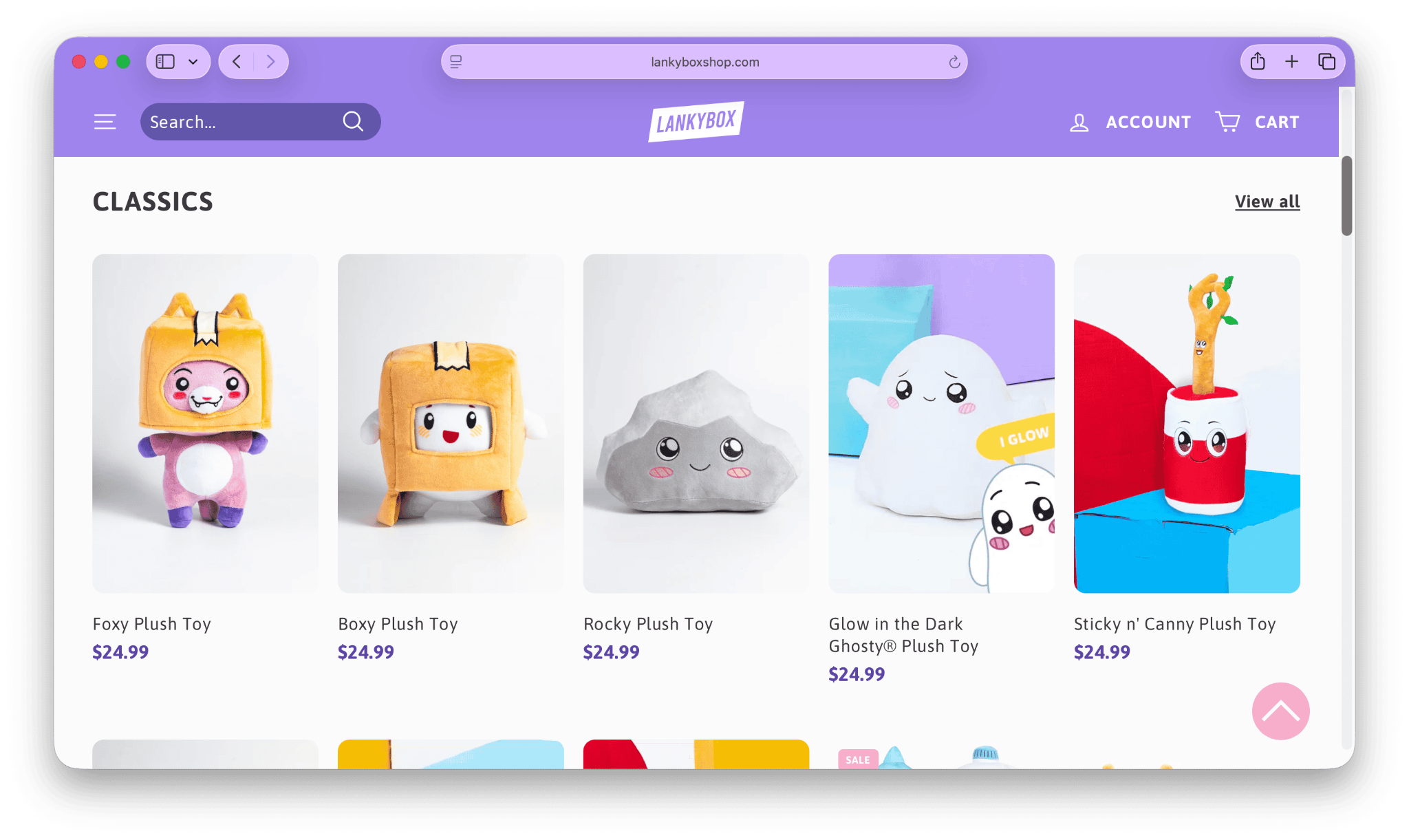
By leaning into plush toys, LankyBox created merchandise that feels less like typical Creator gear and more like standalone products fans would want regardless of where they discovered them.
The products fit the audience
A large portion of LankyBox's audience consists of younger viewers.
For many of these fans, a plush toy or collectible feels more exciting than a t-shirt. The products reflect the same type of entertainment they already enjoy watching on YouTube.
That alignment between audience and product is a big reason the merchandise works.
Many fans buy multiple characters
Another advantage of building around a large cast of characters is that fans rarely stop at one product.
Someone who buys a Foxy plush may eventually want Boxy, Rocky, Ghosty, or another character. The same pattern appears across mystery toys, collectibles, and character bundles.
This creates more opportunities for repeat purchases while making the shopping experience feel more like collecting than buying merchandise.
The merchandise stays connected to the content
One of the smartest parts of the LankyBox merch strategy is its consistency.
The same characters appear across videos, toys, books, backpacks, and other products. Instead of introducing unrelated merchandise, the brand continues building around ideas fans already recognize.
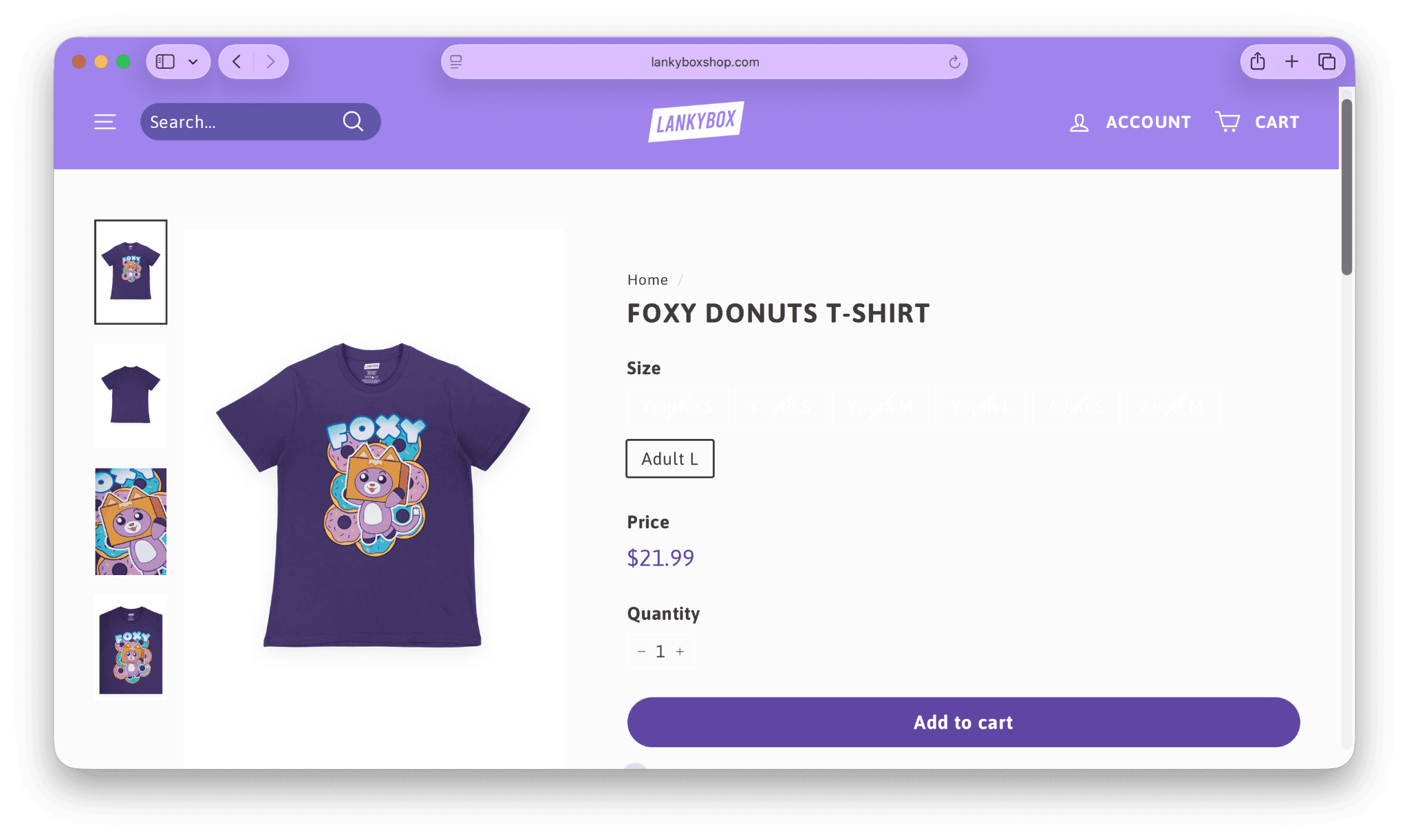
As a result, the products feel connected to the content rather than separate from it. Fans aren't learning a new part of the brand when they visit the store. They're engaging with familiar characters in a different format.
6 Business Lessons Creators Can Learn From LankyBox
LankyBox may look like a Roblox success story on the surface. But when you look closely, several strategic decisions helped transform the channel into something much bigger than a gaming Creator brand.
Here are six lessons Creators can take from LankyBox's growth:
1. Build assets that can outlive your content
Most YouTube videos have a short shelf life.
LankyBox created characters that could appear across videos, toys, books, and retail products. While individual uploads come and go, those characters continue creating value across the business.
Creators who build recognizable assets often have more expansion opportunities than Creators who build around content alone.
2. Meet audiences where they already are
LankyBox didn't try to create demand for a new category.
The team focused on Roblox when interest in the platform was already growing rapidly. Instead of fighting for attention in unrelated niches, they positioned themselves where their target audience was already spending time.
Sometimes the fastest way to grow is to align with an existing audience behavior rather than trying to create a new one.
3. Design content formats that scale
Many Creator businesses find it difficult to grow because every piece of content requires a completely new idea.
LankyBox built repeatable formats around reactions, challenges, gameplay, and trends. That made it easier to publish at a high volume without constantly reinventing the channel.
Scalable formats create more opportunities for growth than one-off content concepts.
4. Build products that match the audience
A younger audience is more likely to get excited about toys and collectibles than premium apparel.
LankyBox understood this and built products that aligned with the interests of its viewers. The result was merchandise that felt relevant to the audience rather than disconnected from it.
The best Creator products usually reflect the audience as much as the Creator.
5. Give fans multiple ways to engage with the brand
Many Creators rely on a single platform to maintain audience attention.
LankyBox expanded into merchandise, books, toys, retail partnerships, and distribution deals. Each touchpoint gave fans another way to interact with the brand outside YouTube.
The more ways people can engage with a brand, the less dependent that brand becomes on any single platform.
6. Think beyond Creator merchandise
One of the most interesting aspects of the LankyBox business is that many of its products don't feel like traditional Creator merch.
Fans aren't buying products simply because Justin and Adam made them. They're buying products connected to characters and experiences they already enjoy.
That's an important distinction. Some of the strongest Creator businesses are built around ideas that can stand on their own, not just around the Creator behind them.
Breaking Down the LankyBox Business Model
Over the years, Justin and Adam have expanded the LankyBox brand into toys, books, retail partnerships, licensing deals, and other businesses.
Despite that expansion, every part of the business still grows from the same foundation. Here's how the different pieces fit together:
1. YouTube is still the foundation
The main LankyBox channel has grown into one of the largest gaming channels on YouTube, generating billions of views across Roblox Videos, challenges, animations, songs, and reaction content.
Those views translate directly into advertising revenue, but that’s only part of the story.
The scale of the audience also gives LankyBox a constant stream of new fans entering the brand every day. That’s important because many of the company’s other revenue streams depend on people first discovering the characters through YouTube.
The business has also expanded beyond a single channel through properties like LankyBox World, creating additional opportunities for content distribution and audience growth.
2. Licensing turned characters into retail products
One of the biggest business moves LankyBox made was turning its characters into licensed products.
Instead of manufacturing and distributing every toy themselves, the company partnered with Bonkers Toys to bring Foxy, Boxy, Rocky, Ghosty, and other characters into retail stores.
That partnership opened up an entirely different revenue stream.
Rather than relying only on YouTube views, LankyBox could now earn revenue from licensed products sold through major retailers and online stores. More importantly, the characters could reach children who may have discovered the brand through YouTube first.
3. Publishing created another entry point
LankyBox has also expanded into publishing through projects like LankyBox: Epic Adventure!.
The graphic novel takes familiar characters and stories from the channel and adapts them into a different format.
While books generate their own revenue, they also serve another purpose. They give fans another way to engage with the brand and help extend the lifespan of the characters beyond individual videos.
4. Distribution partnerships expanded the audience
Another notable piece of the business is distribution.
Through pocket.watch, LankyBox content has been repackaged into shows like LankyBox Ultimate Mishmash, helping the brand reach audiences across streaming and connected TV platforms.
This creates additional licensing and distribution opportunities while introducing the characters to viewers who may spend less time on YouTube.
Conclusion
LankyBox started as a YouTube channel. Today, it's a brand that reaches fans through videos, toys, books, merchandise, and retail products.
What's interesting is that much of that growth didn't come from launching random businesses. It came from repeatedly building around the same ideas, characters, and audience.
That's a pattern we're seeing more often across the Creator economy. As audiences become harder to reach and platforms become more competitive, many Creators are looking for ways to build brands that can exist outside a social feed.
LankyBox shows what that can look like in practice. The business isn't powered by YouTube alone. It's powered by recognizable products, characters, and experiences that fans can engage with wherever they encounter the brand.
In the years ahead, some of the most valuable Creator businesses may not be the ones with the biggest audiences. They may be the ones that create something people recognize even when the Creator isn't in the room.
Connect with LankyBox
FAQ
Justin Kroma and Adam McArthur are not related and are longtime friends who founded LankyBox together in 2016. The pair met before starting the channel and built the LankyBox brand around their creative chemistry rather than a family relationship. They now co-own LankyBox Shop, LankyBox Toys, and LankyBox Publishing, with the business estimated to be worth between $20 million and $40 million.
LankyBox toys are sold at major retailers including Walmart, Target, and Amazon through the brand's licensing partnership with Bonkers Toys. The retail lineup includes plush versions of Foxy, Boxy, Rocky, Ghosty, and other LankyBox characters, along with mystery figure blind boxes and collectible sets. Fans can also buy directly from the official LankyBox Shop online, which carries exclusive apparel and accessories not available in retail stores.
LankyBox content is aimed primarily at kids ages 4 to 12, with Roblox gameplay, reactions, animations, and character-driven videos designed to appeal to younger audiences. The brand's plush toys, apparel, and collectibles target the same age range, which is why LankyBox partnered with kids-focused media company pocket.watch for distribution. Parents often find the content acceptable for young viewers because Justin and Adam keep language, humor, and themes family-friendly across the LankyBox channels.
LankyBox has a distributed series called LankyBox Ultimate Mishmash, released through pocket.watch and available on streaming and connected TV platforms rather than a traditional TV network. The show repackages LankyBox YouTube content and character-driven segments for broader audiences. Beyond the streaming show, LankyBox: Epic Adventure! is a graphic novel that extends the Foxy, Boxy, and Ghosty characters into publishing, giving fans another way to engage with the LankyBox universe outside YouTube.
LankyBox's combined estimated net worth sits between $20 million and $40 million, split across founders Justin Kroma and Adam McArthur and the businesses they co-own. That figure reflects revenue from YouTube ad monetization on 42 million+ subscribers, licensing royalties from Bonkers Toys retail products, LankyBox Shop merchandise sales, publishing income from LankyBox: Epic Adventure!, and distribution deals through pocket.watch. Individual per-year earnings for Justin and Adam are not publicly disclosed.
Richard is Head of Organic Growth at Fourthwall, with 14+ years of experience in the creator economy and ecommerce. He’s built businesses across the spectrum—from print-on-demand stores to custom cut-and-sew clothing lines, as well as selling digital products. He helps creators navigate merch strategy and build sustainable businesses.


You might also like

How Aimee Song Turned an Architecture Portfolio Into a Fashion Brand

How Alix Earle Turned GRWM Videos Into a Netflix Series and a Skincare Brand

Making It Together: Inside Evan & Katelyn's Rise From IKEA Hack to Trusted DIY YouTubers

Brett Chody’s Journey to Building a Community One Mile (and One Bite) at a Time

From Actor to ADHD Educator: How Jessica McCabe Turned a Coping Mechanism into a Credible Brand

How Halley Kate Williams Turned a Pet-Brand Venture into a Full Apparel Collection

How Hopescope Built One of YouTube's Biggest Shopping Channels

How Coyote Peterson Created an Extensive Merch Collection Centered on His Content

How LaurenZside Turned Gaming Videos Into a Multi-Business Creator Brand

Keep up with the latest from Fourthwall
New features, product updates, trend breakdowns, and creator stories — straight to your inbox.