
How Coyote Peterson Created an Extensive Merch Collection Centered on His Content
Lessons in Brand-Building from the Internet's Favorite Wildlife Daredevil


Coyote Peterson, the wildlife educator behind Brave Wilderness's 21 million-subscriber YouTube channel, built a nearly 100-item Fourthwall merch store organized around distinct content pillars like the Brave Kids Collection and Sting Zone Collection, alongside a book series and licensed stock wildlife footage. His approach shows how protecting IP early, structuring merch around brand identity rather than generic logos, and diversifying revenue streams that reinforce one mission can turn a YouTube channel into a durable, multi-platform business.
Building a merch collection doesn’t need to be hard.
For most Creators, building an online store filled with items inspired by your content is a no-brainer. Because when it comes down to it, all you need to know is what items make the most sense for you and your audience.
Creators like Coyote Peterson have thrived in this department.
For nearly a decade, the wildlife educator and YouTuber has built a massive audience through his crazy nature videos, in which he lets himself be stung or bitten by some of the world's most dangerous animals.
His popularity, charisma, and in-depth knowledge of wildlife have not only allowed him to expand his brand into television, books, and paid wildlife experiences, but also enabled him to create an extensive merch collection for both children and adults.
This Creator Spotlight takes a deep look at how Coyote Peterson turned his passion for wildlife and turned it into a business that reaches millions.
We’ll also explore how he built a merch line that feels like a natural extension of his content, and what his approach can teach other Creators trying to turn an audience into something more durable than ad revenue.
Stepping into the Wild: Building a Channel Off Critter Love
Coyote Peterson grew up in Newbury, Ohio, in a town with no fast-food restaurants and, notably, no Starbucks.
His love of animals started early, with him and his sister spending their childhood running loose in the creek behind their house, catching bullfrogs, painted turtles, and water snakes.
The most dangerous thing in the neighborhood was a common snapping turtle, which, fittingly, became his lifelong favorite animal.
He never had any formal training, with most of his knowledge coming from books, hands-on experience, and what he describes as a near-photographic memory paired with fast hand-eye coordination.
By the time he reached The Ohio State University, animals had taken a back seat to "typical teenage-type things." What stuck, instead, was storytelling.
Peterson became fascinated with why films made people feel the way they did, and he wanted to learn how to produce that feeling himself.
Ohio State didn't have a film program, so he built his own. He pieced together a personalized cinema major by taking classes from multiple departments to learn writing, producing, business, and law. He had no interest in ever being in front of a camera.
He hosted a screenwriting competition and then directed the university's first feature film in over 25 years.
The idea for Brave Wilderness came together with his business partner, Mark Vins, while both were working day jobs. They spent more than five years developing the concept, originally casting a different on-camera host while Peterson directed and wrangled the animals from behind the scenes.
It wasn't until production executives repeatedly asked where the animals came from that Peterson showed them behind-the-scenes footage of himself catching them. That's when everyone realized the real star of the show wasn't the animals—it was Peterson himself.
They launched the Brave Wilderness YouTube channel in 2014, seeing it as a way to bypass Hollywood gatekeepers entirely.
As Peterson put it, going the YouTube route meant no executives, no parent company, and basically full control of their own intellectual property.
That control came from a deliberate early decision to protect their IP legally, using an entertainment attorney to make sure they weren't signing away the rights to their own footage or likeness while pitching the concept around town.
It took nearly a decade of unpaid effort (the channel didn't generate consistent revenue until 2016) before the "glorified hobby," as Peterson has called it, became a career.
From there, the brand expanded steadily.
In 2020, he landed his own Animal Planet series, Coyote Peterson: Brave the Wild, and has continued to create wildlife adventures through 2026, including a recent collaboration with wildlife filmmaker Casey Anderson to explore a remote animal boneyard in Yellowstone National Park.
Even after moving away from the “sting and bite” videos that made him famous, Peterson has stayed active by finding new ways to educate and entertain his audience.
Expanding a Wildlife Brand into Merchandise
Over the years, Peterson has established himself as a prominent voice in wildlife education on social media and in television.
Today, Brave Wilderness remains one of the top wildlife channels on YouTube.
With more than 21 million subscribers, the show has expanded into several additional YouTube channels, including individual channels for Peterson and Vins, a Top Videos channel with 239K subscribers that features the brand’s most extreme moments, and 12 foreign-language channels dubbed for viewers in Bulgaria, France, Italy, Ukraine, India, and other countries.
That popularity has allowed Peterson not only to expand his brand into other media but also into merchandising, where he has successfully capitalized on his wild antics by building a product line that extends the Brave Wilderness experience beyond the screen.
Shop Brave Wilderness
When it comes to merch collections, ShopBraveWilderness doesn’t limit itself to creativity or product selection.
With nearly 100 items spanning across nine collections, this merch store (hosted on Fourthwall) offers a variety of apparel, accessories, drinkware, and even stimulant beverages.
The Brave Kids Collection targets the show's younger demographic with friendly designs and integrates with Peterson’s Sting Zone Collection, which features colorful illustrations of some of the most dangerous creatures encountered.

The Coyote Peterson Collection and the Mark Vins Collection split the brand between the show’s two personalities, with Peterson’s collection offering more on-brand apparel, such as “Howl at the Moon” crewnecks and “Coyote’s Sketchbook” tees, while Vins’ leans more into the Brave Wilderness brand.
When it comes to sustainability, Brave Wilderness offers about 20 eco-friendly shirts and hoodies throughout their collections, each made from 100% organic cotton. For an audience that already cares about animals and the environment, sustainably made apparel isn't an extra detail to entice shoppers—it signals the brand’s credibility.
Rounding out the store is the Field Notes and Artifacts Collection, which offers custom notebooks, stickers, magnets, mugs, and posters featuring Peterson’s “Sting Index” with the Executioner Wasp front and center on most of the designs, as well as the “Be Brave, Stay Wild” slogan incorporated on every poster.
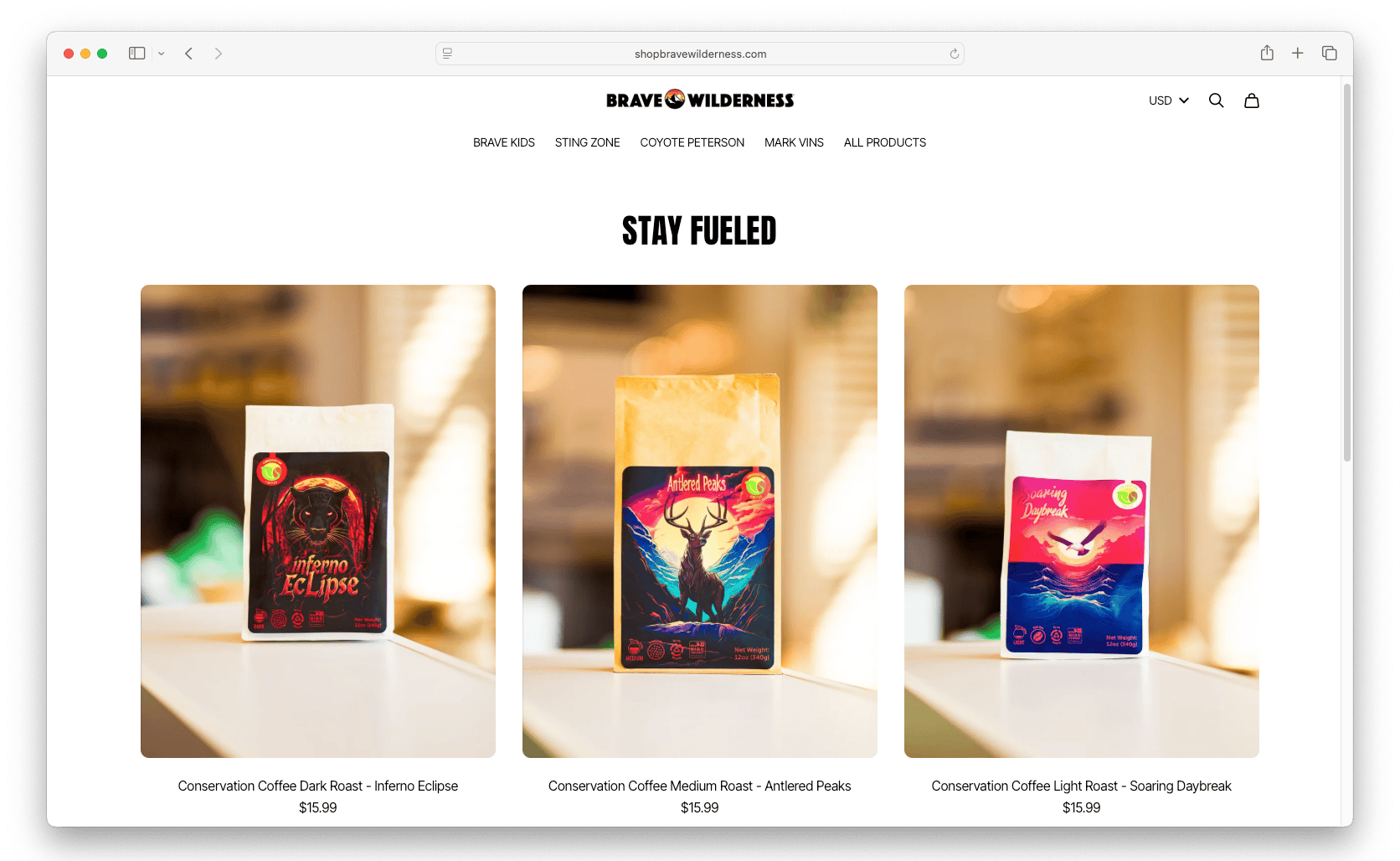
But what really sticks out in this store is Brave Wilderness’s own brand of Conservation Coffee that comes in three different blends. What’s unique about this product is its mission.
A portion of every purchase supports global conservation projects through their partnership with the Smithsonian Migratory Bird Center, which also ensures the coffee is certified organic and shade-grown using environmentally responsible farming practices.
It's a small but telling detail. One that turns a simple coffee purchase into proof that Brave Wilderness's environmental message isn't just something Peterson talks about on camera, but something built into how the business actually runs.
Book Collection
Peterson's book series is a case study in itself, showcasing a Creator who recognized his brand's true value and expanded it into a format that YouTube alone couldn't offer.
Titles like Brave Adventures: Wild Animals in a Wild World and Epic Encounters in the Animal Kingdom take the same first-person, in-the-moment storytelling that made his videos popular and translate it into a reading experience, chronicling everything from his first childhood snapping turtle catch to encounters with an 800-pound grizzly.

Rather than simply repackaging existing video content, he adapted his format to fit each medium, with books like The King of Sting and The Beast of Bites leaning into narrative recaps of his most painful on-camera moments, while Wildlife Adventure and Color the Wild shift entirely into interactive formats built for kids, complete with write-in activities, stickers, and coloring pages.
That range shows real publishing instincts as he's not just selling one book, but an entire shelf spanning different reading levels and engagement styles, from older fans who want the deeper first-person stories to younger kids who just want to color a picture of a bullet ant.
It's a smart move for a Creator of his stature. Most influencers stop at merch or a single tie-in book, but Peterson built a genuine bibliography that turns his platform into a recurring educational resource families return to again and again, not just a one-time impulse buy.
Stock Wildlife Videography
Beyond merch and books, Peterson's team has found a third revenue stream that most outdoor Creators overlook: licensing their own raw footage as stock video.
Through Pond5 and Shutterstock, Peterson and the Brave Wilderness team have been selling stock video under the handle WildernessProd.
Each platform offers hundreds of high-def videos, featuring the kind of production value most Creators never think to monetize, with shots like aerial drones sweeping coastlines and rainforest canopies, a mother dolphin and calf breaching in open water, and up-close shots of insects and critters in their natural habitat.

For someone in Peterson's line of work, it's genuinely a smart monetization avenue because the footage already exists. Every trip his crew takes to film a new episode generates hours of usable drone and wildlife footage that never makes it into a final YouTube cut.
So, rather than letting that footage sit unused, Brave Wilderness can license it online, turning it into a recurring income stream.
For other Creators sitting on hours of unused b-roll, location shots, or high-quality photography, Peterson's approach is a reminder that content doesn't have to be "finished" or fan-facing to have value.
What Creators Can Learn from Peterson's Career
Peterson's path from backyard turtle-catcher to a multi-platform brand didn't happen by accident. It was built on deliberate decisions made years before any of them paid off, with each piece reinforcing the next.
For Creators looking to build something similarly durable, his career offers a handful of concrete lessons worth borrowing.
Build the Identity Before the Store
Merch works best when people already know what your brand stands for.
If your audience doesn't have a clear idea of who you are or what makes your content unique, your products can end up feeling like generic items with your logo on them.
That's what Coyote Peterson got right. He spent years building his reputation as the fearless wildlife expert who gets up close with some of the world's most fascinating animals.
By the time he launched his merch, fans already knew exactly what his brand represented, making every product feel like a natural extension of the content they already loved.
Structure Merch Around Content Pillars, Not Generic Branding
Rather than treating "merch" as one category, each of Peterson's collections is built around a specific audience segment or brand pillar—kids, sustainability, headwear, accessories, and favorite stings.
That structure means a shopper can find something that speaks directly to the part of the brand they actually care about, instead of sorting through one undifferentiated pile of logo gear.
Protect Your IP Early
Peterson's insistence on legal ownership of his footage and likeness from the very beginning is what let him negotiate a licensing deal with Discovery later on his own terms, rather than someone else's.
Creators who skip this step risk building an audience for a brand they don't fully own once bigger opportunities come calling.
This can leave them negotiating from a position of weakness if a platform or network realizes that the leverage lies with whoever holds the rights, not with whoever built the following.
Diversify Without Fragmenting
YouTube, television, books, merch, and even stock footage all point back to the same mission (wildlife education and adventure) instead of pulling the brand in unrelated directions.
That coherence means every new revenue stream strengthens the same identity rather than diluting it or confusing the audience about what the brand actually stands for.
Conclusion

Coyote Peterson's merchandising success isn't the result of flashy product designs or aggressive marketing. It comes from staying true to the brand he's built from the very beginning.
Every collection in his store, every book, and every piece of adventure gear reflects the same mission that made Brave Wilderness successful: inspiring people, especially kids, to explore and appreciate the natural world.
That's the biggest takeaway for Creators looking to launch their own merch.
Don't just create products for the sake of selling something. Instead, make merchandise that feels like a natural extension of the content your audience already enjoys.
Pay attention to the videos, jokes, catchphrases, characters, or moments your fans connect with most, and let those be the inspiration for your designs rather than chasing the latest trends or guessing what might sell.
FAQ
Coyote Peterson's real name is Nathaniel Peterson, and he grew up in Newbury, Ohio, before picking up the Coyote nickname as a kid. He kept it as his on-screen persona when he and business partner Mark Vins launched the Brave Wilderness YouTube channel in 2014, which has since grown to more than 21 million subscribers.
Coyote Peterson has an estimated net worth between $4 million and $8 million as of 2026, drawn from Brave Wilderness YouTube revenue, book royalties, his ShopBraveWilderness merch store, stock footage licensing on Pond5 and Shutterstock, and his Animal Planet series Coyote Peterson: Brave the Wild. The Brave Wilderness main channel alone counts more than 21 million subscribers across nearly a dozen dubbed foreign-language channels. Peterson has not publicly confirmed a specific figure.
The Executioner Wasp is the most painful sting on Coyote Peterson's Brave Wilderness Sting Index, which he ranks above the bullet ant and tarantula hawk. Peterson has said the Executioner Wasp's venom produced hours of full-body burning pain, and the wasp anchors most of the artwork in his Field Notes and Artifacts merch collection, alongside the recurring Be Brave, Stay Wild slogan.
Coyote Peterson is still producing wildlife content in 2026, though he has largely moved away from the sting-and-bite videos that made Brave Wilderness famous. His most recent projects include a Yellowstone National Park boneyard expedition with wildlife filmmaker Casey Anderson, ongoing episodes of his Animal Planet series Coyote Peterson: Brave the Wild, and steady new uploads across the Brave Wilderness YouTube network and its 12 dubbed foreign-language channels.
Coyote Peterson is based in Ohio, where he grew up in the small town of Newbury and attended The Ohio State University. He runs Brave Wilderness production out of the state rather than relocating to a Los Angeles or New York media hub, using Ohio as a home base for filming trips around the world for both Brave Wilderness episodes and his Animal Planet series.
Matt Keyser is a writer at Fourthwall who lives at the intersection of social media and Creator culture. With 4+ years of experience covering industry trends, his work focuses on helping Creators and brands understand how to turn their passion into a thriving business while maintaining a constant pulse on the latest eCommerce and social media trends.


You might also like

How Alix Earle Turned GRWM Videos Into a Netflix Series and a Skincare Brand

Making It Together: Inside Evan & Katelyn's Rise From IKEA Hack to Trusted DIY YouTubers

Brett Chody’s Journey to Building a Community One Mile (and One Bite) at a Time

From Actor to ADHD Educator: How Jessica McCabe Turned a Coping Mechanism into a Credible Brand

How Halley Kate Williams Turned a Pet-Brand Venture into a Full Apparel Collection

How Hopescope Built One of YouTube's Biggest Shopping Channels

How LaurenZside Turned Gaming Videos Into a Multi-Business Creator Brand

How Chris Heria Built One of YouTube's Biggest Calisthenics Brands

Manage Your Fourthwall Shop From ChatGPT

Keep up with the latest from Fourthwall
New features, product updates, trend breakdowns, and creator stories — straight to your inbox.